How many times have you been teaching Tabletop, Plank or Downward-Facing Dog and noticed a student's elbows extend beyond 180 degrees? If you've spent much time around yoga, you've probably heard the cue: "Micro-bend your elbows to protect your joints." I've certainly used variations of it myself in the past. It seems sensible. If someone's elbows move beyond what we think of as straight, particularly if we know that person is hypermobile, asking them to back away from that position can feel like the safer option.
But I've become increasingly interested in what we're actually trying to achieve with that cue. Are we helping the student explore another way of supporting themselves, or are we assuming that because a joint looks hyperextended, something harmful is happening? Those are two quite different things.
What are we actually seeing?
First, it's worth distinguishing between locking the elbow and hyperextending the elbow. Locking simply means taking the elbow to its available end range of extension, and that end range varies between people. Studies looking at healthy elbows have found variation in how far people can actively and passively extend the joint, influenced by factors including age, sex and individual anatomy (Chapleau et al., 2019). At the end of extension, the olecranon process of the ulna moves into the olecranon fossa of the humerus, meaning that the shape of our bones contributes to where that end range occurs.
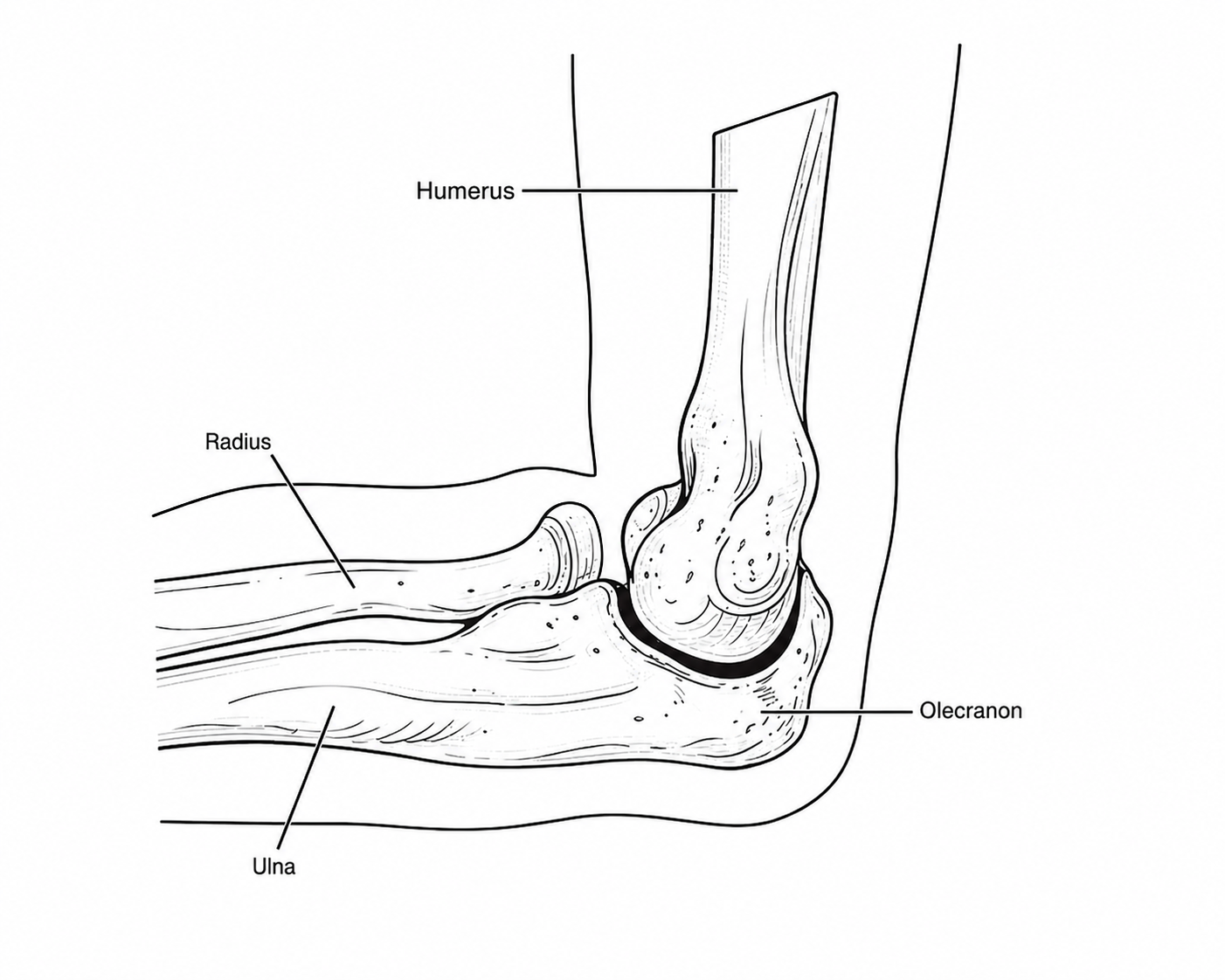
The word hyperextension can also create some confusion. In yoga, we commonly use it simply to describe an elbow that extends beyond 180 degrees. This isn't the same as a hyperextension injury, where a joint has been forcibly taken beyond the range it can tolerate. Being able to hyperextend the elbows also doesn't, by itself, tell us that someone has generalised joint hypermobility. The Beighton score, one commonly used clinical screening tool for generalised joint hypermobility, considers elbow extension of more than 10 degrees beyond neutral, but the elbows account for only two of the nine possible points (The Ehlers-Danlos Society, 2017). So, when we see an elbow bending beyond 180 degrees in Tabletop, its appearance alone tells us relatively little about the person attached to it.
Is locking the elbow actually harmful?
If a student comfortably bears weight through an elbow at its available end range, we shouldn't assume that they are damaging the joint simply because it looks hyperextended. The elbow is supported by a combination of the shape of the joint, ligaments and muscles crossing it, with both passive and active structures contributing to stability (Karbach & Elfar, 2017). Even at full extension, muscles around the elbow continue to contribute when the joint is loaded (Riach & Reid, 1980).
Of course, that doesn't mean everyone should always lock their elbows either. Perhaps loading the elbow in that position is painful. Perhaps changing the elbow position makes a pose feel more comfortable at the wrist or shoulder. Or perhaps we deliberately want to increase the muscular challenge by asking the student to explore supporting themselves somewhere else in their available range. This is why I've become less interested in asking, "Should this student lock their elbows?" and more interested in asking, "What are we trying to achieve right now?"
A micro-bend can therefore be a very useful cue. Asking someone to support themselves slightly away from their usual end range changes the muscular demands of the task. But that's quite different from telling someone that they should always micro-bend because locking their elbows is dangerous. Imagine having naturally hypermobile elbows and being asked to maintain a micro-bend every time you're in Tabletop, Plank or Downward-Facing Dog. That can become a considerable muscular challenge.
Rather than turning the micro-bend into another rule, I think it's much more useful to see it as another movement option. Can the student comfortably support themselves at end range? Can they also support themselves slightly away from it? Can they move between those strategies depending on what they're trying to do?
Building more movement options:
One way to explore this is through co-contraction, where muscles on both sides of a joint are active at the same time. Starting in Tabletop, find a gentle bend in your elbows and then create an isometric action by attempting to draw your hands towards or away from one another. Notice what happens around your arms and shoulders, and what happens when you subsequently try to straighten your elbows.
I've recorded a short tutorial that walks you through this exploration:
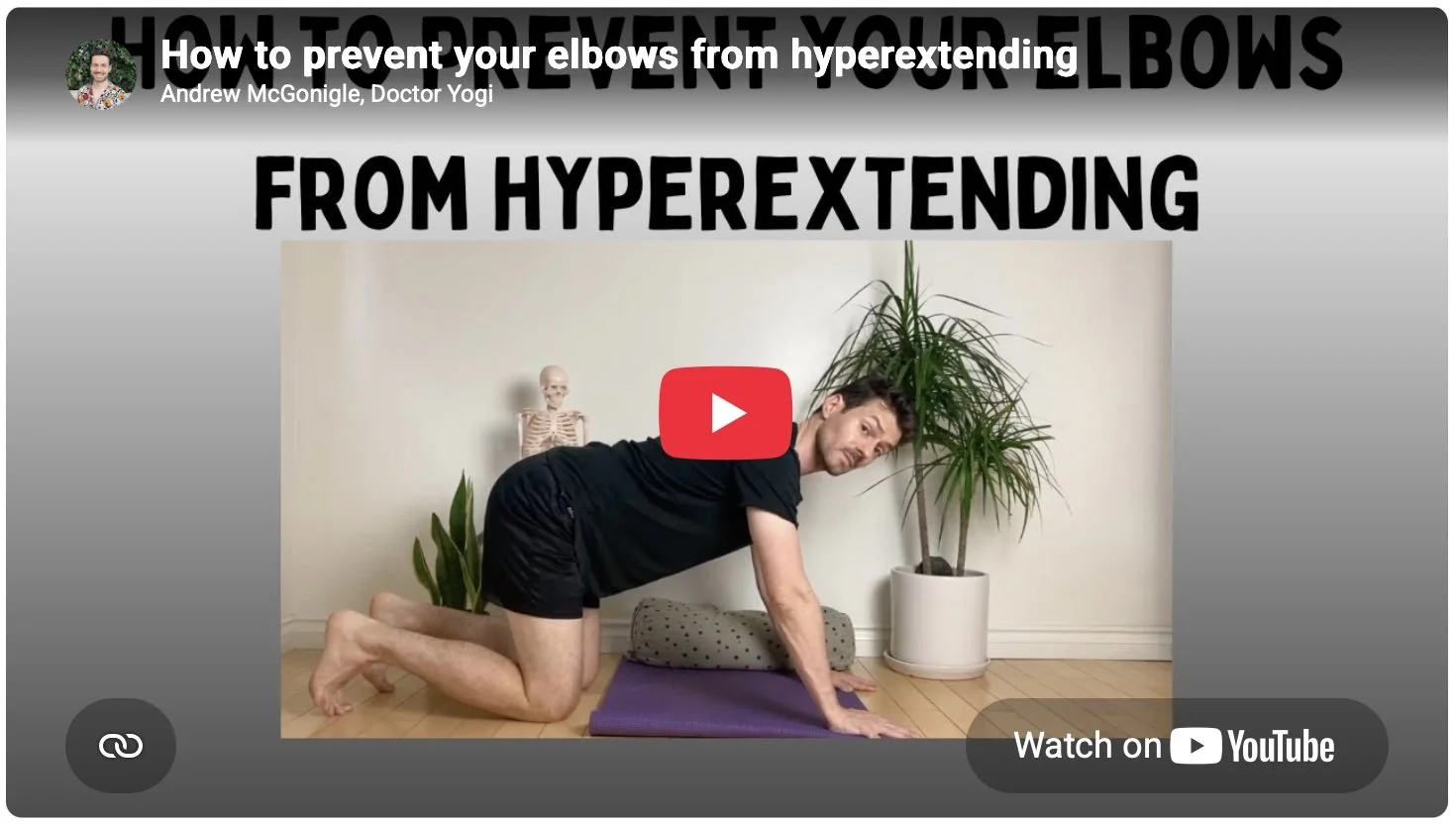
I don't think of this as an exercise for fixing elbow hyperextension. Instead, it gives someone another way of organising muscular effort while bearing weight through their arms. We're not trying to take a movement option away, we're adding another one. And I think the elbow is a useful example of a much bigger question that comes up when teaching hypermobile students: what should we actually do when someone moves into a large range?
It's tempting to create simple rules. Always micro-bend the elbows. Don't hang into end range. Don't stretch too much. Avoid Yin Yoga. The problem is that a large range doesn't tell us whether someone has control there, whether they can tolerate load there, whether the position is painful, or why they're choosing that particular strategy. There will absolutely be times when encouraging a student to explore a different position is useful, but rather than seeing hyperextension and immediately trying to correct it, perhaps we can become a little more curious.
Does this hurt? What happens if we change it? Can you comfortably support yourself somewhere else in the range? What are we hoping to develop by asking you to do that?
Those questions give us considerably more information than the shape of someone's elbow. They also help us move away from language such as "micro-bend your elbows to protect your joints." If the purpose of the cue is to increase muscular effort, explore another strategy or simply notice what changes, why not say that?
The more I've explored hypermobility, the less interested I've become in telling people which ranges they should and shouldn't use. I'm much more interested in whether we can help students develop the confidence and capacity to have choices within those ranges. Next time you see an elbow bending beyond 180 degrees in Tabletop, perhaps that's a more interesting place to begin.
References:
Chapleau, J., Canet, F. & Petit, Y. (2019). Demographic and anthropometric factors affecting elbow range of motion in healthy adults. Journal of Shoulder and Elbow Surgery, 28(4), 713–719.
Karbach, L.E. & Elfar, J. (2017). Elbow instability: Anatomy, biomechanics, diagnostic maneuvers, and testing. Journal of Hand Surgery, 42(2), 118–126.
Riach, C.L. & Reid, J.G. (1980). An electromyographic study of weight-bearing at the elbow joint. Canadian Journal of Applied Sport Sciences, 5(4), 220–225.
The Ehlers-Danlos Society. (2017). The Beighton score: How to assess joint hypermobility.