We’ve all experienced joint noises. Perhaps your knees crack when you squat, your hip clicks when you move your leg, or you’re one of those people who enjoys cracking their knuckles. Words such as cracking, grinding and popping don't exactly sound reassuring, so it is easy to understand why we might interpret them as evidence that something inside a joint is rubbing, wearing away or gradually deteriorating. But how much can we actually learn about the health of a joint from the noises it makes?
How common are noisy joints?
The medical term for joint noises is crepitus, and one thing we know quite confidently is that it is extremely common. A recent systematic review brought together research involving more than 36,000 people and estimated that around 41% of the general population experiences knee crepitus (Couch et al., 2025). Perhaps more interestingly, the researchers found crepitus in around 36% of people with no knee pain or previous knee injury.
This isn't an entirely new observation. McCoy et al. (1987) detected patellofemoral crepitus (noise coming from around the kneecap) in 99% of a group of people without knee pain, and Robertson (2010) highlighted that crepitus can be present without underlying joint pathology (disease or damage). I find these figures interesting because they challenge a fairly intuitive assumption. If a joint sounds unusual, it is tempting to assume that something unusual, and potentially harmful, must be happening inside it. Yet apparently healthy, pain-free joints can be remarkably noisy.

What is actually making the noise?
You might imagine that modern imaging and decades of research would allow us to explain exactly what is happening every time a joint clicks or pops. The answer is surprisingly less certain. We still don't completely understand the origins of all the sounds our joints produce. There is agreement that the formation of a bubble or cavity within the synovial fluid (the lubricating fluid inside a joint) is involved in some types of crepitus, although the precise process and source of the resulting sound are still debated. Other noises may come from soft tissues such as tendons moving over neighbouring structures.
Clicks, pops, cracks, grinding and grating may therefore have different explanations, and a particular sound doesn't necessarily provide us with a reliable window into what is happening inside a joint. Even grinding or grating noises, which can sound particularly alarming, may occur without pain or evidence that the joint is being harmed. A noisy joint and an unhealthy joint are not necessarily the same thing.
Does cracking your knuckles cause arthritis?
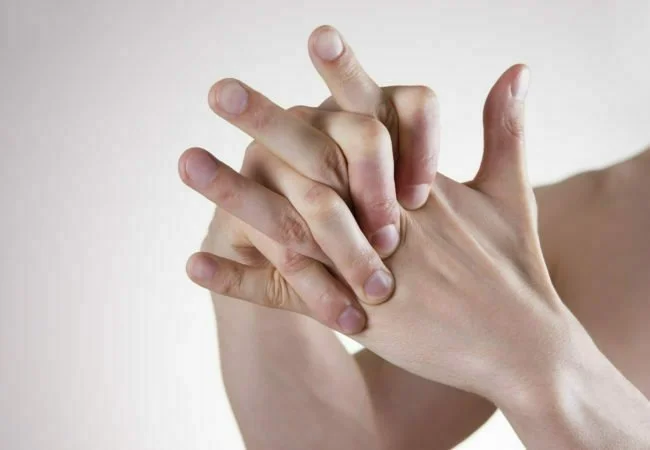
Few joint noises have accumulated quite as much folklore as knuckle cracking. Many of us probably grew up hearing that repeatedly cracking our knuckles would eventually give us arthritis, but there doesn't appear to be evidence that this is the case.
One of my favourite pieces of research on the subject came from Californian physician Donald Unger, who spent decades regularly cracking the knuckles of only one of his hands while leaving the other alone. After all those years, he found no apparent difference in arthritis between the two hands (Unger, 1998). An experiment involving one very committed participant obviously cannot settle the question by itself, but I love the story because it makes me wonder how many other beliefs about our bodies become accepted simply because they sound plausible and have been repeated often enough.
When the meaning becomes more important than the noise
This brings us to the part of the research that I find particularly interesting. Robertson et al. (2017) interviewed people with patellofemoral pain (pain around or behind the kneecap) about their experiences of knee crepitus. Participants commonly associated the noises with degeneration, damage and premature ageing. Some described feeling old because of what their knees sounded like, and these beliefs could influence their behaviour, including making them less inclined to be physically active.
I hadn't really considered this aspect of joint noises until I came across this research. We can become so interested in identifying the physical source of a click or crack that we overlook the effect the noise might have on the person hearing it. The sound itself may not necessarily be harmful, but if someone interprets it as evidence that their joint is deteriorating, that interpretation could change how comfortable they feel walking, exercising or getting down onto the floor.

What does this mean for yoga teachers?
Yoga teachers are in a useful position to help demystify joint noises. When a student's knee cracks in Chair Pose or their hip clicks as they move their leg, they may already have a story about what that sound means. Perhaps they've been told that their joints are wearing out, that something is rubbing where it shouldn't, or that the noise is a warning to stop. As we've seen, however, clicks, cracks, pops and even grinding sounds are remarkably common, including in healthy, pain-free joints. When there are no accompanying symptoms, we can help students understand that a noisy joint isn't necessarily a problematic joint.
Of course, context still matters. If a new or changing joint noise is accompanied by pain or other symptoms, that gives us additional information and may be a reason to encourage someone to seek advice from an appropriate healthcare professional. But when someone has a joint that regularly clicks, cracks or grinds without any associated symptoms, I don't think our first instinct needs to be finding a way to stop it. We can reassure them that bodies make noises and that the sound alone doesn't mean their joint is being damaged.
I think this is particularly important because the meaning we attach to joint noises can influence behaviour. If students come to believe that every crack or grind is evidence of degeneration, they may become wary of movements that are otherwise comfortable for them. Part of our role as teachers can be to challenge that story rather than reinforce it. Sometimes the most useful response to a noisy joint may simply be: “That’s very common. If it isn’t causing you any pain or other symptoms, it isn’t necessarily something we need to change.”
References:
Couch, J., et al. (2025). “Noisy knees-knee crepitus prevalence and association with structural pathology: a systematic review and meta-analysis.” British Journal of Sports Medicine, 59(2), 126–132.
McCoy, G., McCrea, J., Beverland, D., Kernohan, G. and Mollan, R. (1987). “Vibration arthrography as a diagnostic aid in diseases of the knee.” Journal of Bone and Joint Surgery (British Volume), 69-B(2), 288–293.
Robertson, C. (2010). “Joint crepitus, are we failing our patients?” Physiotherapy Research International, 15, 185–188.
Robertson, C., Hurley, M. and Jones, F. (2017). “People's beliefs about the meaning of crepitus in patellofemoral pain and the impact of these beliefs on their behaviour: A qualitative study.” Musculoskeletal Science and Practice, 28, 59–64.
Unger, D. (1998). “Does knuckle cracking lead to arthritis of the fingers?” Arthritis and Rheumatism, 41(5), 949–950.