Bhramari breathing, often called bee breath, is widely taught as a soothing, grounding practice, yet many of the explanations given in yoga teacher trainings are not strongly supported by science. As teachers, we can offer Bhramari with clarity when we understand what is known, what is emerging and what is still uncertain.
This newsletter summarises the evidence in a clear and accessible way so that you can teach Bhramari with confidence, inclusivity and scientific accuracy.
👉What We Know About Bhramari
1. Slow, controlled breathing changes physiology
There is strong evidence that slow breathing with a prolonged exhalation shifts the autonomic nervous system towards parasympathetic activity. This includes reductions in heart rate, changes in heart rate variability and an overall calming effect on the body. These responses occur across many breath practices that emphasise steady, lengthened exhalation.
Slow breathing also changes the mechanical and chemical environment of the respiratory system. The gentle reduction in breathing frequency, the slight rise in carbon dioxide and the extended out-breath all support a state associated with rest, recovery and emotional regulation. These findings are well established in respiratory physiology and are consistent with systematic reviews on slow breathing practices (Zaccaro et al 2018).
Bhramari is one of several pranayama techniques that use prolonged exhalation, which means it can reliably support down-regulation even though its more specific mechanisms, such as vibration, remain an area of ongoing research.

2. Low-frequency vibration may contribute to relaxation
Bhramari creates vibration in the throat, chest and face. Low-frequency vibration has been associated in some research with changes in emotional regulation and a shift towards parasympathetic activity, although most findings relate to external vibrational interventions rather than self-produced humming. These findings should be interpreted cautiously.
Stephen Porges has suggested that vocal resonance and vibration may support vagal pathways through the structures of the upper airway (Porges 2011). This is an influential idea, although it remains a hypothesis and requires further research.
It is appropriate to mention Porges’ work because many yoga teachers encounter these ideas, as long as we clarify that the current evidence is not conclusive.
3. Bhramari increases nitric oxide in the nasal passages
This is one of the clearest and most reliable findings in the Bhramari literature.
Humming significantly increases nitric oxide levels in the nasal passages, in some studies up to fifteen times compared with quiet exhalation (Weitzberg and Lundberg 2002). Nitric oxide is involved in regulating airway tone, sinus ventilation and local vascular function. These roles are well established.
Although nitric oxide has been linked to wider physiological processes, its direct relationship with emotional regulation is not yet understood. We cannot say that nitric oxide is responsible for the calming effect of Bhramari, but we can state confidently that humming increases nasal nitric oxide and that this supports healthy airflow and sinus function.
This gives us a grounded and accurate explanation to offer our students without overstating what nitric oxide does.
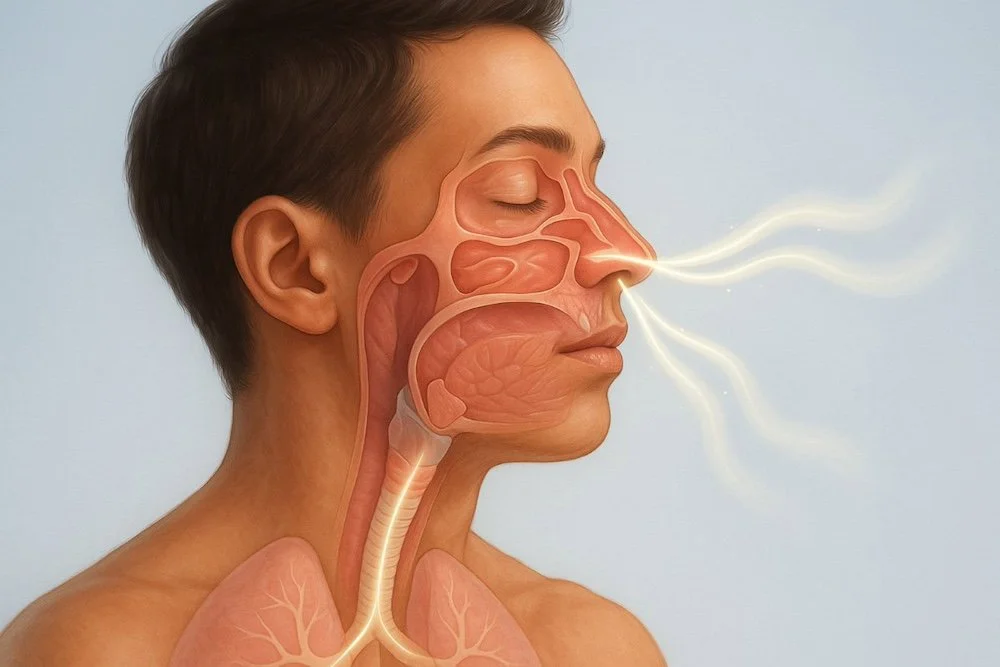
4. Subjective calming is common and meaningful
Even if the mechanisms are still being explored, many practitioners report that Bhramari feels calming, soothing or grounding. Slow breathing, extended exhalation, gentle vibration and the sensory focus all contribute to this experience.
Subjective benefits are especially important for students who seek simple tools they can practise anywhere.
Encouraging students to notice their own felt sense helps them connect with the practice without relying on unproven claims.
👉How to Teach Bhramari Without Common Myths
Many teacher trainings attribute Bhramari’s effects to direct vagus nerve stimulation or precise changes in brain waves. These claims are not supported by strong evidence.
Instead, we can keep our wording simple, accurate and empowering.
Focus on slow breathing, sensory awareness, vibration, lengthened exhalation and a grounded sense of presence. This supports both scientific accuracy and inclusivity.
👉Accessibility Matters in Pranayama Too
Not all students feel comfortable creating sound or vibration. Some may have trauma histories, sensory sensitivities, social anxiety or respiratory challenges. Others may simply feel self-conscious.
To make Bhramari accessible, offer a silent variation. Invite students to imagine they are humming or to imagine airflow moving through the face, throat or nasal passages while maintaining slow, steady breathing. Imagined breath pathways can create similar attentional shifts and can offer many of the calming benefits of slow, focused exhalation. This option preserves agency, psychological safety and personal choice.
References:
Balban, M. Y., et al. (2023). Breathwork enhances autonomic regulation, mood and stress resilience in adults. Cell Reports Medicine, 4(1), 100895.
Porges, S. W. (2011). The Polyvagal Theory, Neurophysiological Foundations of Emotions, Attachment, Communication and Self Reguation. W. W. Norton.
Telles, S., and Singh, N. (2018). Science of the mind, body and breath, yoga research and public health. International Journal of Yoga, 11(2), 79 to 80.
Weitzberg, E., and Lundberg, J. O. N. (2002). Humming greatly increases nasal nitric oxide. American Journal of Respiratory and Critical Care Medicine, 166(2), 144 to 145.
Zaccaro, A., et al. (2018). How breath control can change your life, a systematic review on psychophysiological correlates of slow breathing. Frontiers in Human Neuroscience, 12, 353.