Many yoga teachers have heard the cue, “relax the glutes in backbends,” while others teach the opposite, “engage the glutes to protect the lower back.” Both views are common in yoga spaces and are often presented with a lot of certainty, but when we step back and look at anatomy and biomechanics, the picture becomes more nuanced. Let’s explore what physiology actually suggests.
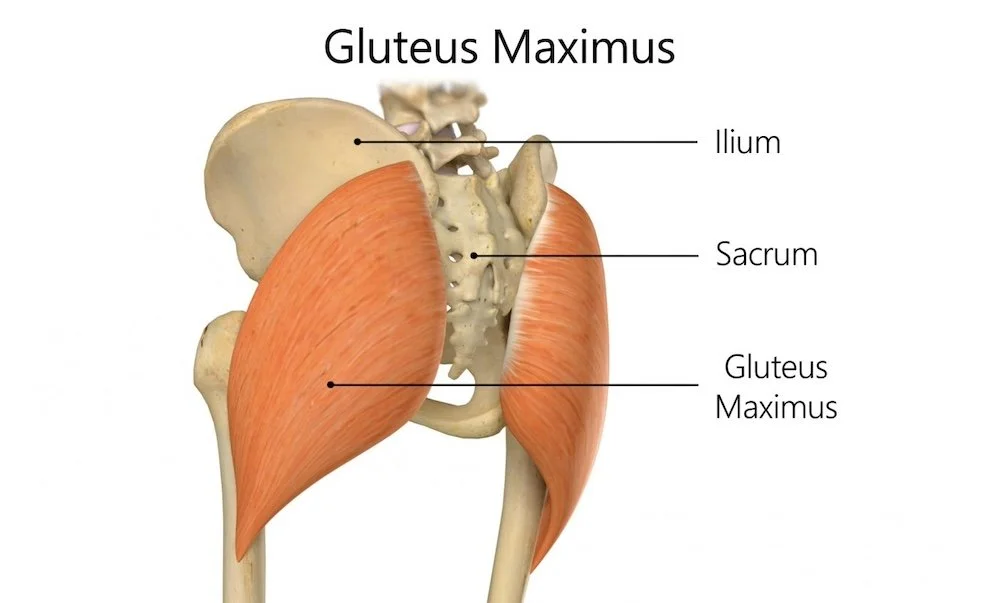
The gluteus maximus is the largest and most powerful hip extensor in the body.
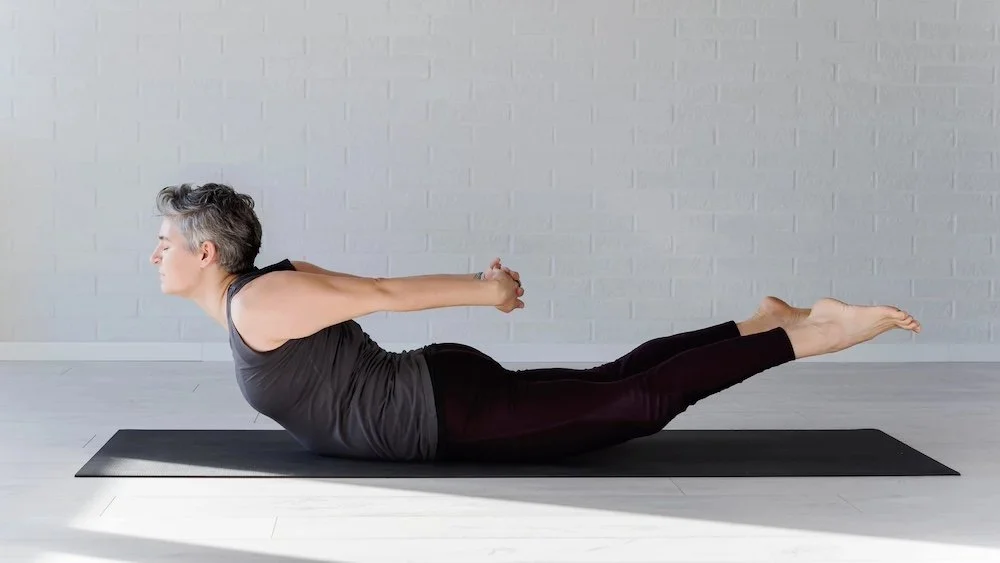
Hip extension occurs when the thigh moves backwards relative to the pelvis. This movement is central to many backbends, including Bridge Pose, Locust Pose, and Urdhva Dhanurasana.
Other muscles contribute to hip extension, including the hamstrings and the posterior fibres of adductor magnus, but the gluteus maximus is typically the primary driver of this movement (Neumann, 2017).
For this reason, it is very common for the gluteus maximus to be active during movements that involve hip extension. Electromyography studies consistently show gluteus maximus activation during bridging, hip extension tasks, and similar movements (Distefano et al., 2009).
From a basic anatomy perspective, it would therefore be surprising if the glutes were completely relaxed during many backbending movements.
Do the Glutes Compress the Lower Back?
One of the most common claims in yoga education is that engaging the glutes compresses the lumbar spine. However, when we look at anatomy, this explanation does not hold up particularly well.
The gluteus maximus does not cross the lumbar spine. Its main attachments are the posterior ilium, the sacrum, the coccyx, the iliotibial band, and the femur. Because the muscle does not attach to the lumbar vertebrae, it cannot directly compress the lumbar spine.
It is also worth remembering that the spine is not a fragile structure that must avoid all compression. Throughout the day, the spine naturally experiences cycles of loading and unloading. Intervertebral discs tend to lose a small amount of height during the day under compressive forces and rehydrate again during periods of rest, a normal and well-documented physiological process.
Compression itself is not inherently harmful. The body is well adapted to tolerate and respond to these forces.
This does not mean that spinal loading cannot occur in backbends. It simply means that attributing lumbar compression specifically to glute contraction is an oversimplification.
What About the Sacrum and SI Joint?
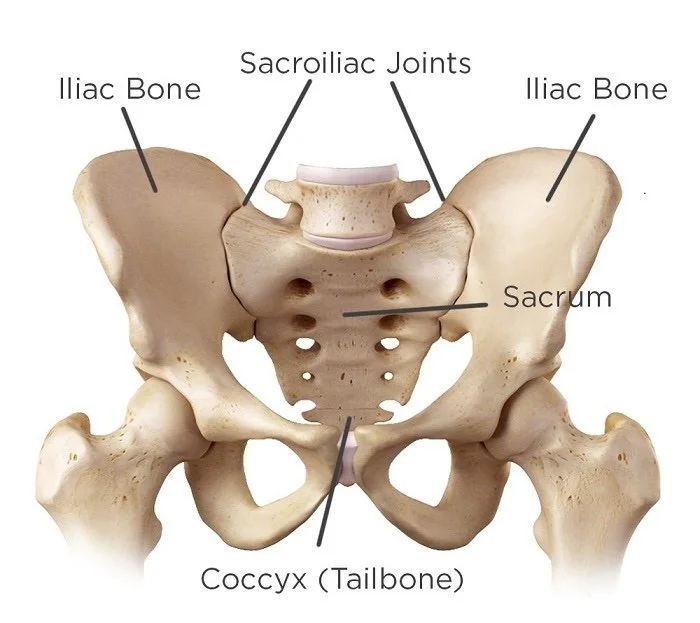
Another common concern is that glute contraction “jams” the sacrum or sacroiliac joints.
The gluteus maximus does attach partly to the sacrum, and its contraction can increase compression across the sacroiliac joint. However, this compression is not necessarily problematic.
In biomechanics research, compression across the sacroiliac joint is often described as force closure, a mechanism that contributes to joint stability during movement (Vleeming et al., 2012).
In other words, some compression is a normal and functional part of how the joint stabilises during movement.
Where Pain Science Fits In
Some educators approach this discussion through the lens of modern pain science.
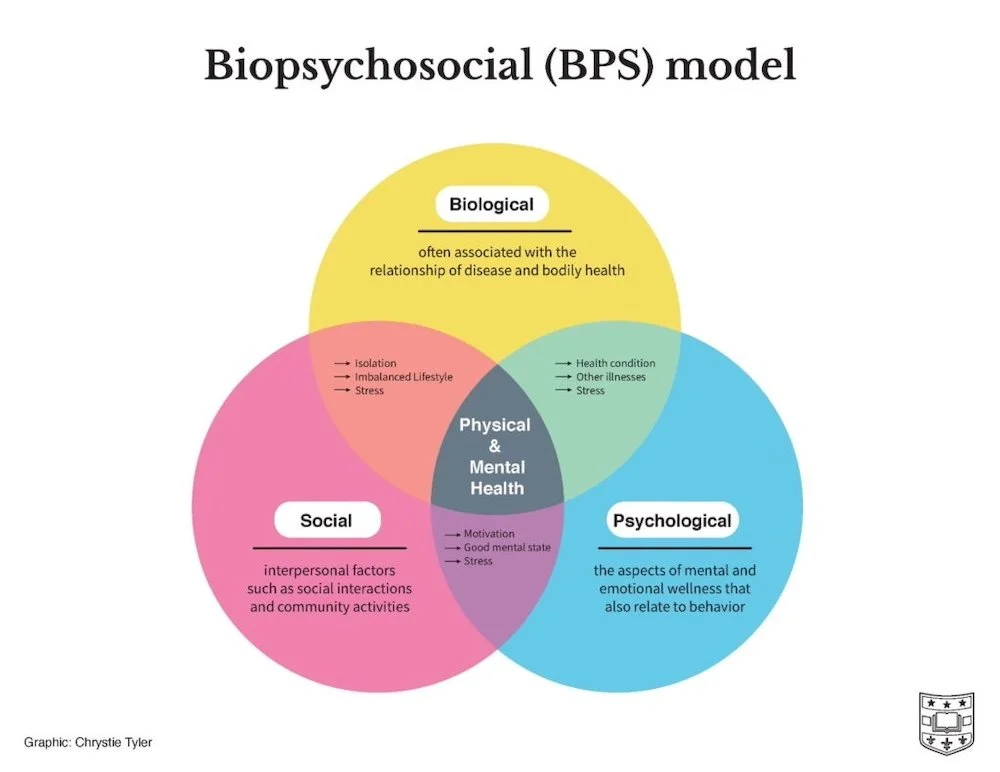
Pain is not simply an input from tissues. Rather, it is a complex output of the nervous system influenced by many factors, including sensory input, past experiences, expectations, and context (Moseley and Butler, 2017).
This biopsychosocial understanding of pain is important for teachers to appreciate.
However, recognising the complexity of pain does not mean that biomechanics becomes irrelevant. Movement patterns, loading, and tissue stress can still influence how the body adapts to activity.
In practice, both perspectives can inform teaching.
A More Useful Question
Instead of asking whether the glutes should be “on” or “off”, a more helpful question may be:
How much glute engagement is useful for this person in this movement?
For some students, activating the glutes may support hip extension and make the movement feel stronger or more stable.
For others, strong contraction may feel restrictive or uncomfortable.
Human movement is variable. Different people organise extension movements in different ways.
Rigid rules rarely reflect the complexity of real bodies.
Practical Takeaways for Yoga Teachers
Rather than insisting on a single correct cue, teachers might consider a more exploratory approach.
You might invite students to:
• Notice how the pose feels with different levels of glute engagement
• Explore distributing extension across both hips and spine
• Avoid language that suggests certain muscles are inherently dangerous to activate
• Focus on comfort, breath, and overall coordination
For some practitioners, engaging the glutes creates a sense of support and power.
For others, softening them slightly may create more ease in the movement.
Both experiences can be valid.
Key Takeaways
The gluteus maximus is the primary extensor of the hip.
It commonly activates during movements that involve hip extension, including many backbends.
The muscle does not cross the lumbar spine, so it cannot directly compress the lumbar vertebrae.
Compression across the sacroiliac joint can be a normal stabilising mechanism.
Pain is influenced by many biological, psychological, and social factors.
There is unlikely to be one universal cue that works for every body.
References:
Distefano, L. J., Blackburn, J. T., Marshall, S. W., and Padua, D. A. (2009). Gluteal muscle activation during common therapeutic exercises. Journal of Orthopaedic and Sports Physical Therapy, 39(7), 532–540.
Moseley, G. L., and Butler, D. S. (2017). Explain Pain Supercharged. Adelaide Pain Biology Institute.
Neumann, D. A. (2017). Kinesiology of the Musculoskeletal System: Foundations for Rehabilitation (3rd ed.). Elsevier.
Vleeming, A., Schuenke, M. D., Danneels, L., and Willard, F. H. (2012). The functional coupling of the deep abdominal and paraspinal muscles, the thoracolumbar fascia, and the sacroiliac joints. Journal of Anatomy, 221(6), 537–567.