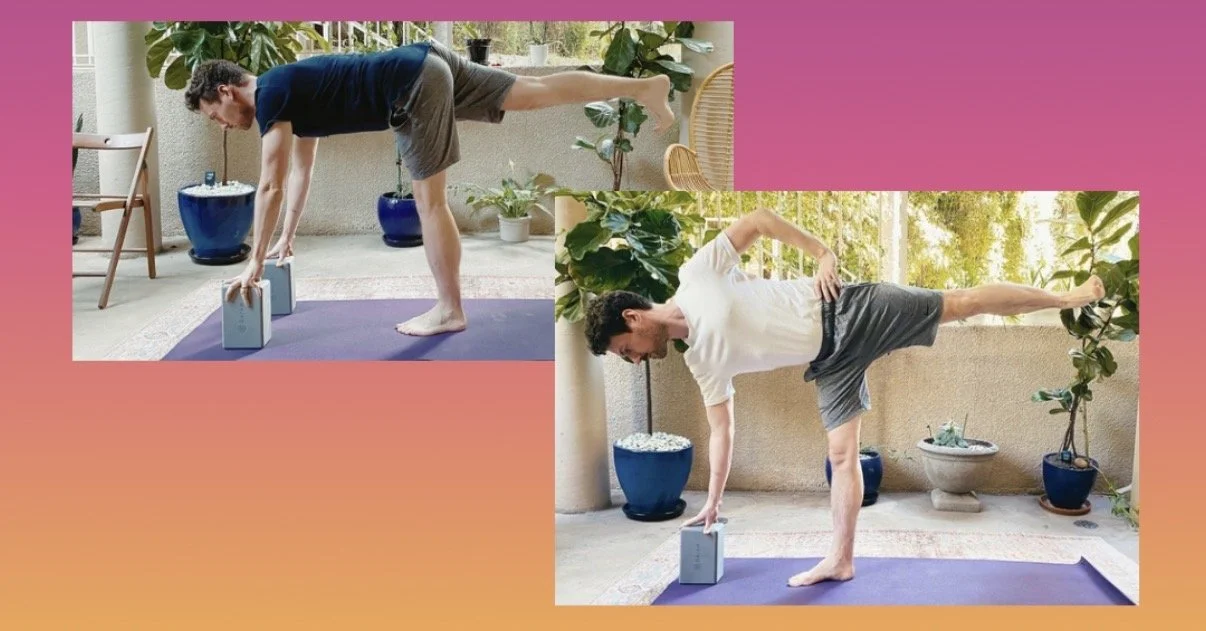
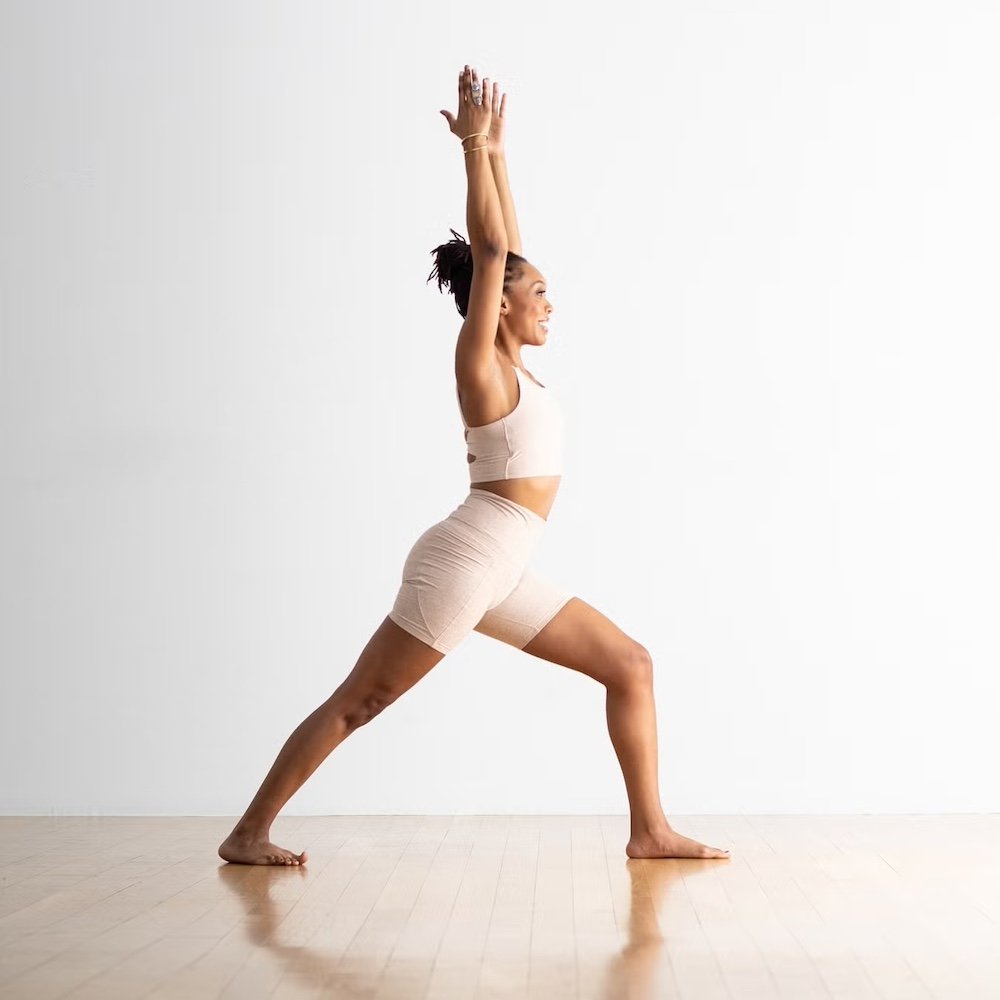
Yoga-related hip issues have received significant attention in recent years, and many teachers are now questioning whether transitions between so-called “open” and “closed” hips are inherently risky. Common examples include moving from Warrior 3 to Half Moon Pose, or from Warrior 1 to Warrior 2. This question has become more common as conversations around hip labral tears and structural findings have grown within yoga and movement spaces.
This article is adapted from an excerpt from Supporting Yoga Students with Common Injuries and Conditions.
What Do We Mean by “Open” and “Closed” Hips?
In yoga spaces, “open hips” is often used to describe positions involving more external rotation and abduction at the hip, while “closed hips” typically refers to more neutral or internally rotated positions. These terms are not precise anatomical definitions but rather teaching shorthand. The hip joint is designed to move through a wide range of positions, including combinations of flexion, extension, rotation, and abduction. Moving between these positions is a normal part of human movement.
Anecdote Versus Evidence
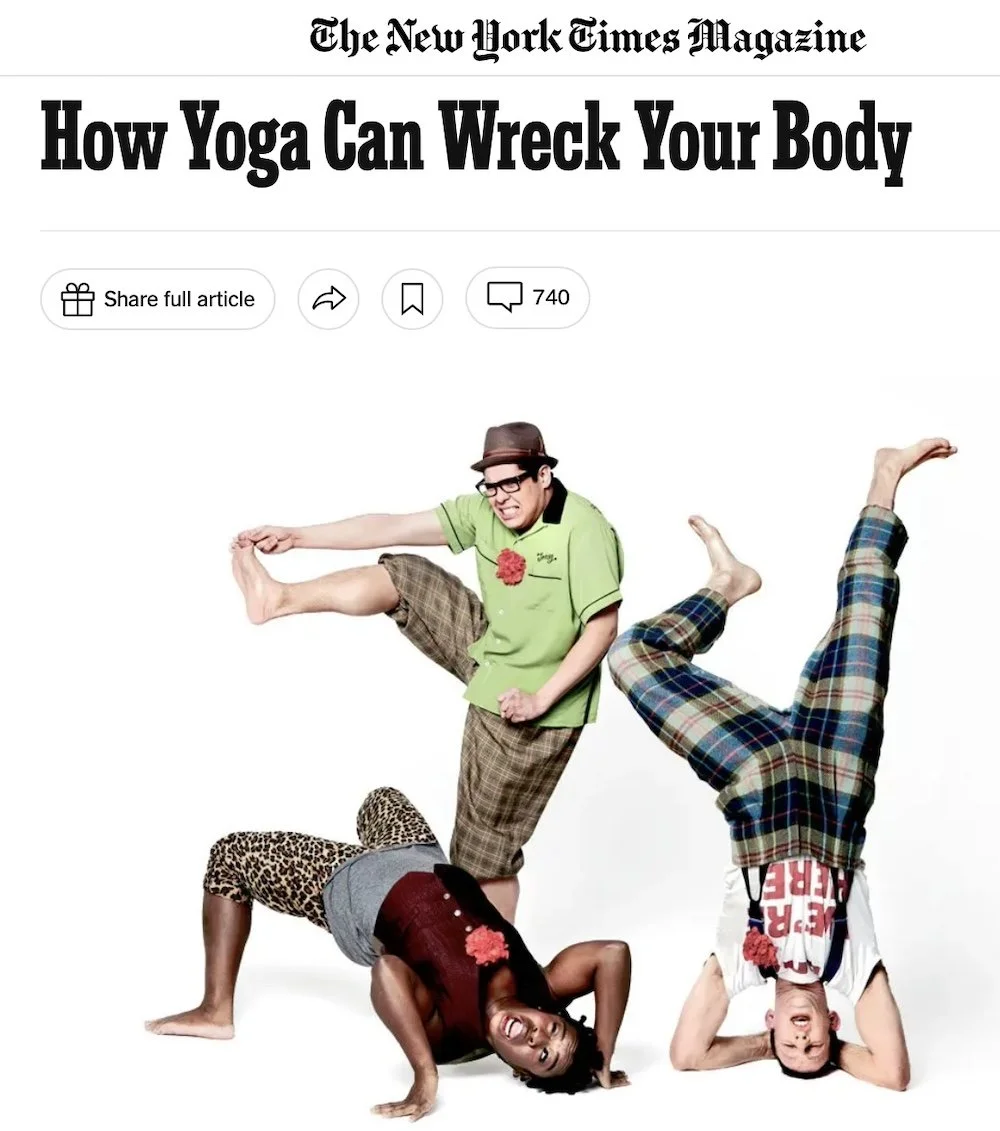
Many claims linking specific hip movements to injury are based on anecdote rather than high-quality research. At present, there are no studies that directly investigate whether transitions between “open” and “closed” hip positions are harmful. While personal experience can be a valuable learning tool, it does not always generalise. As teachers, it is easy to assume that what feels uncomfortable in our own bodies will be problematic for everyone, but this is not necessarily the case.
Some of the wider concern about yoga and hip injuries was amplified by media coverage, including a widely shared New York Times article, which drew heavily on anecdotal reports. This attention later contributed to more formal research into yoga safety. A systematic review by Cramer et al. (2015) concluded that yoga is generally safe when practised appropriately, with low rates of adverse events, comparable to or lower than other forms of physical activity.
Understanding the Labrum and Structural Findings
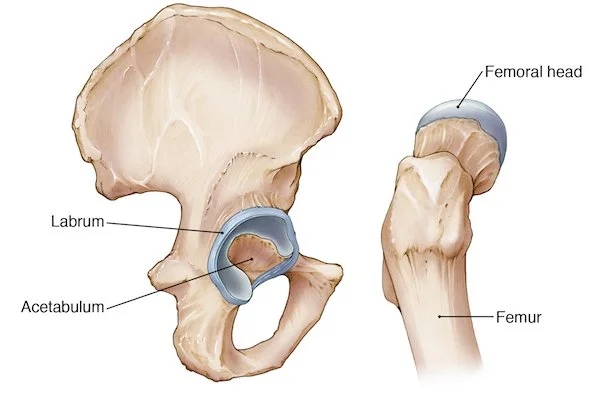
Much of the concern around “dangerous” hip movement focuses on the labrum, the fibrocartilaginous rim that surrounds the acetabulum of the hip joint. However, the underlying causes of labral tears are not clearly understood. Guanche and Sikka (2005) did not find a clear association between running and labral tears, suggesting that repetitive movement alone may not be a primary cause.
Other research highlights how common these findings are, even in people without pain. Groh and Herrera (2009) reported that labral abnormalities are frequently identified in asymptomatic individuals, with incidence increasing with age. Tresch et al. (2017) found that 57% of adults aged 20 to 50 with no hip pain had cartilage defects and or labral tears on MRI. This suggests that some structural changes may reflect normal variation and part of the natural human aging process rather than pathology.
For teachers, this is an important reminder that imaging findings do not always correlate with symptoms, and that the presence of a labral tear does not necessarily mean a student should avoid specific movements.
What This Means for Transitions in Yoga
If a transition such as Warrior 3 to Half Moon Pose can be performed with control and feels comfortable, it is likely to be well tolerated by the weight-bearing hip. The hip joint is designed to manage load across a variety of positions, and gradual exposure to movement can support adaptability.
Rather than viewing transitions between “open” and “closed” hips as inherently risky, it may be more helpful to consider factors such as control, load management, and individual capacity. Moving slowly, using support such as blocks, and reducing range of motion are all practical ways to scale these transitions.
Teaching Through Exploration, Not Avoidance
This conversation highlights the value of inquiry-based learning in yoga. If we remove movements entirely based on generalised concerns, we may limit a student’s opportunity to explore what works for their body. Instead, offering options and encouraging curiosity can help students develop a more nuanced understanding of their own movement.
This is particularly relevant for students with hypermobility or a history of injury, who may need more time and guidance to build confidence. Their path may involve refining control, reducing range, or modifying transitions, rather than avoiding them altogether.
Practical Teaching Takeaways
For yoga teachers, a few key principles can help guide decision-making. Avoid labelling movements as universally safe or unsafe, as context matters. Encourage students to move with control and to notice how transitions feel rather than how they look. Offer variations, including the use of props or slower transitions, to accommodate different needs. Reinforce that discomfort is not always a sign of harm, but that persistent or sharp pain may warrant modification.
Final Thoughts
The current evidence does not support the idea that moving between “open” and “closed” hip positions is inherently harmful. The hip is a highly adaptable joint, and variability in structure and experience is normal. As teachers, our role is to help students navigate movement with awareness, confidence, and appropriate support.
References:
Cramer, H., Ward, L., Saper, R., Fishbein, D., Dobos, G., and Lauche, R. (2015). The safety of yoga, a systematic review and meta-analysis of randomised controlled trials. American Journal of Epidemiology, 182(4), 281–293.
Ferguson, S., Bryant, J., Ganz, R., and Ito, K. (2003). An in vitro investigation of the acetabular labral seal in hip joint mechanics. Journal of Biomechanics, 36, 171–178.
Groh, M., and Herrera, J. (2009). A comprehensive review of hip labral tears. Current Reviews in Musculoskeletal Medicine, 2, 105–117.
Guanche, C., and Sikka, R. (2005). Acetabular labral tears with underlying chondromalacia, a possible association with high-level running. Arthroscopy, 21(5), 580–585.
Tresch, F., Dietrich, T., Pfirrmann, C., and Sutter, R. (2017). Hip MRI, prevalence of articular cartilage defects and labral tears in asymptomatic volunteers, a comparison with a matched population of patients with femoroacetabular impingement. Journal of Magnetic Resonance Imaging, 46, 440–451.