In a world full of opinions, wellness trends, and conflicting advice, it can be tempting to look for certainty, the one right way to practise yoga, breathe, move, eat, or teach.
But yoga teachers are increasingly navigating a landscape where bold claims are everywhere. Social media, podcasts, trainings, books, and even experienced teachers may present ideas with confidence, despite limited evidence.
Critical thinking does not require cynicism. It simply asks us to pause, reflect, and examine how we know what we think we know.
This week’s newsletter explores why critical thinking matters for yoga teachers, how bias shapes our beliefs, and how we can communicate with more clarity, humility, and confidence. Based on an excerpt from The Physiology of Yoga.
What is critical thinking?
According to philosopher-educators Richard Paul and Linda Elder, critical thinking is “the art of analysing and evaluating thinking with a view to improving it” (Paul and Elder 2019).
At its core, critical thinking involves asking better questions:
● What evidence supports this claim?
● What assumptions am I making?
● Could there be another explanation?
● Am I only seeking information that confirms what I already believe?
Critical thinking is not about having all the answers. It is about learning how to evaluate ideas more carefully and communicate more honestly.
For yoga teachers, this matters because students often look to us for guidance and explanation. The way we communicate about yoga can either reinforce confusion and certainty, or encourage curiosity and nuance.
Why uncertainty can feel uncomfortable
Humans naturally prefer certainty. We like simple explanations and clear rules.
That can make yoga myths especially appealing:
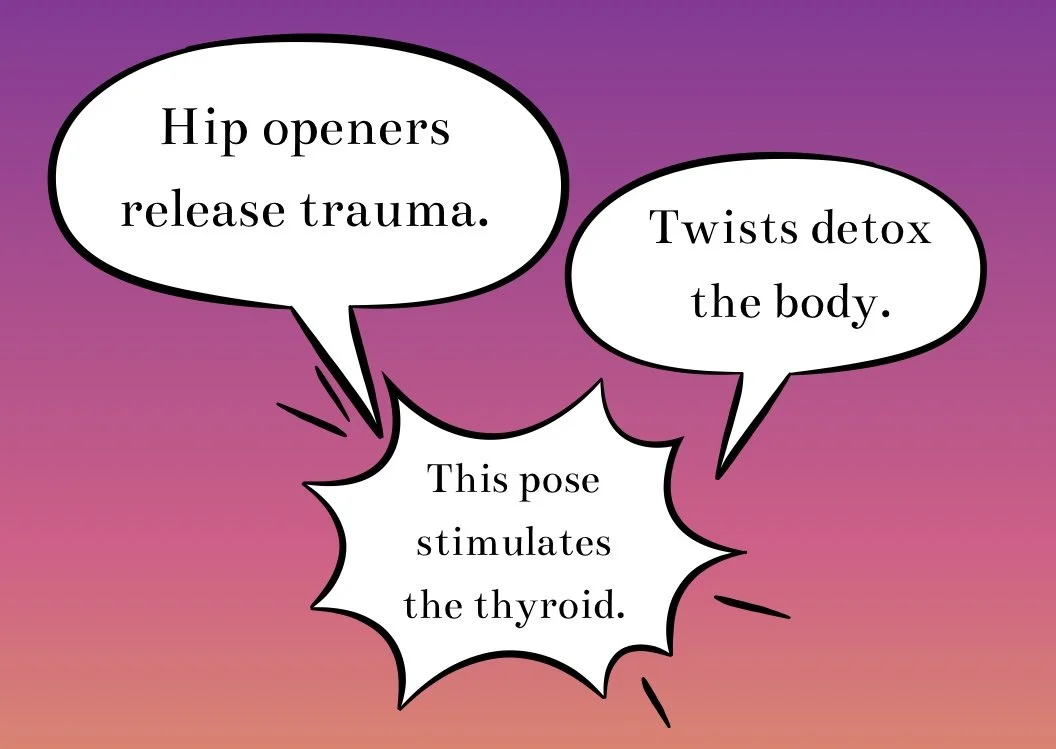
● “This pose detoxifies the liver.”
● “Hip openers release trauma.”
● “Shoulder Stand stimulates the thyroid.”
● “There is one correct alignment for everyone.”
These ideas can feel reassuring because they offer simple answers to complex questions.
But repetition is not evidence.
As philosopher Bertrand Russell famously wrote, “The fact that an opinion has been widely held is no evidence whatever that it is not utterly absurd” (Russell 1929).
Just because a claim is repeated in teacher trainings, books, or online posts does not automatically make it physiologically accurate.
Confirmation bias and the yoga world
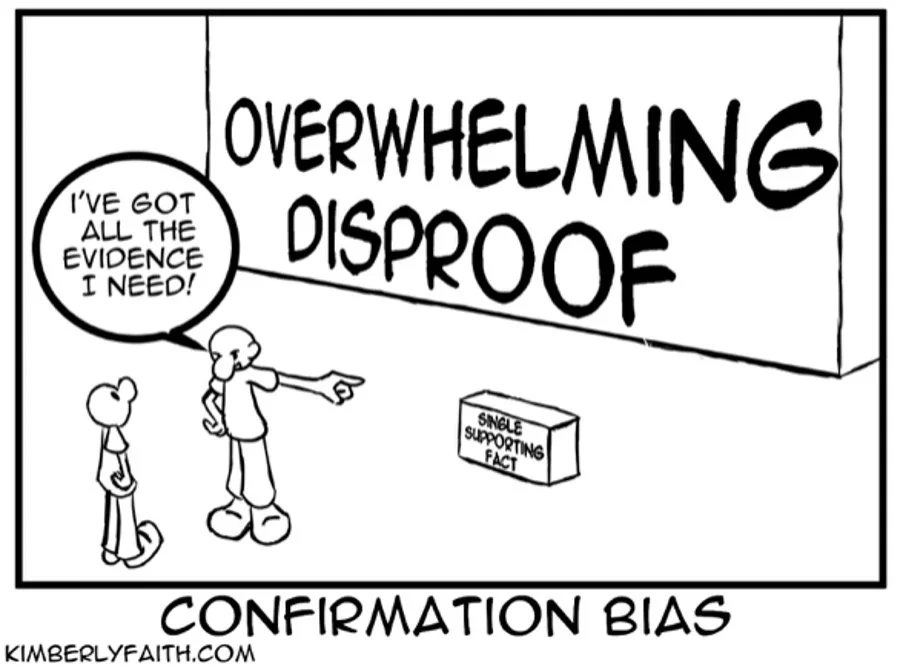
One of the biggest challenges in critical thinking is confirmation bias.
Confirmation bias is our tendency to favour information that supports our existing beliefs while ignoring information that challenges them.
For example:
● If we strongly believe breathwork always calms the nervous system, we may overlook situations where it increases anxiety.
● If we believe a pose healed our pain, we may assume the pose itself was the cause.
● If we admire a teacher, we may become less likely to question their claims.
This does not make us irrational or unintelligent. It makes us human.
Critical thinking asks us to become more aware of these tendencies, not to eliminate them completely.
What counts as evidence?
Evidence is information that helps support or challenge a claim.
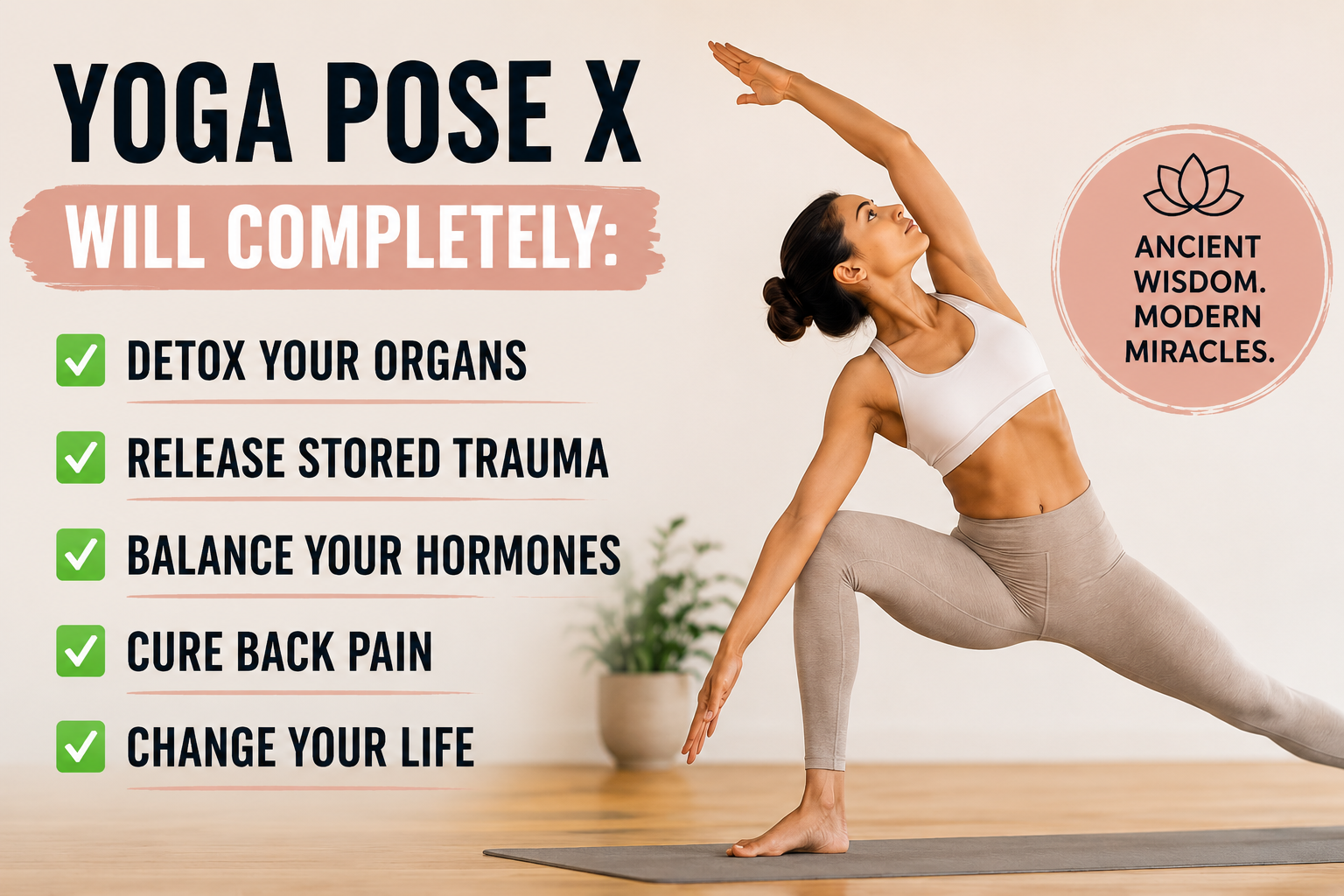
In yoga spaces, many claims are presented without strong evidence or without plausible physiological explanations.
For example:
● Does twisting “wring out toxins” from organs?
● Does a particular pose stimulate a gland?
● Can one breathing technique universally regulate emotions for everyone?
These ideas are often speculative rather than evidence-based.
That does not mean yoga has no benefits. In fact, research continues to support yoga in many contexts, including stress reduction, balance, physical activity participation, and quality of life for some populations (Cramer et al. 2013; Büssing et al. 2012).
But critical thinking asks us to distinguish between:
● what has evidence,
● what is plausible but uncertain,
● and what is simply repeated without support.
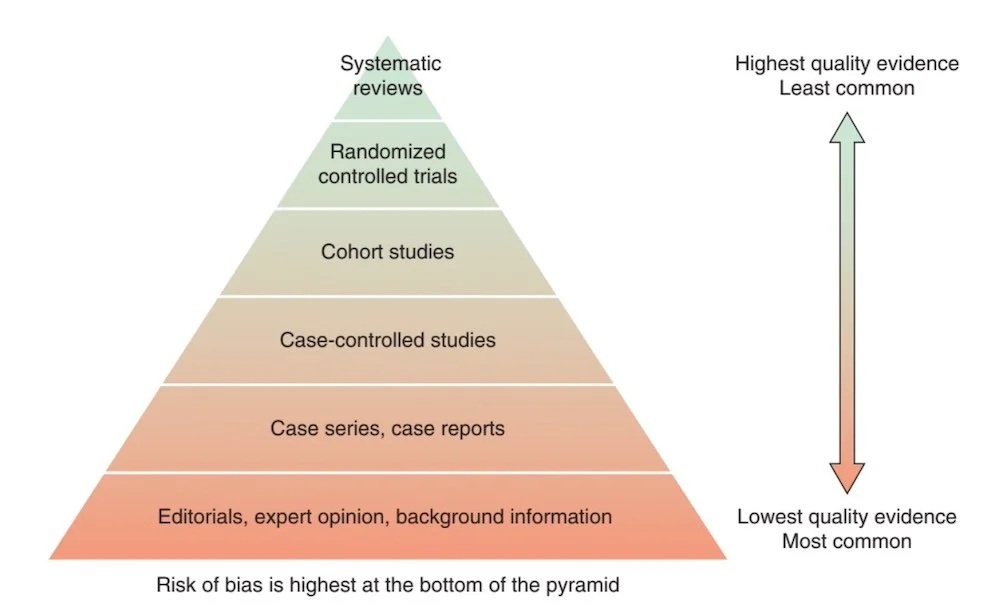
Understanding the hierarchy of evidence
Not all evidence carries the same weight.
In science, researchers often refer to a hierarchy of evidence. At the top are systematic reviews and meta-analyses, which analyse many studies together. Lower down are individual studies, case reports, expert opinions, and anecdotal observations.
This matters because:
● a single study rarely provides definitive answers,
● expert opinion can still be biased,
● and personal experience, while meaningful, does not always establish causation.
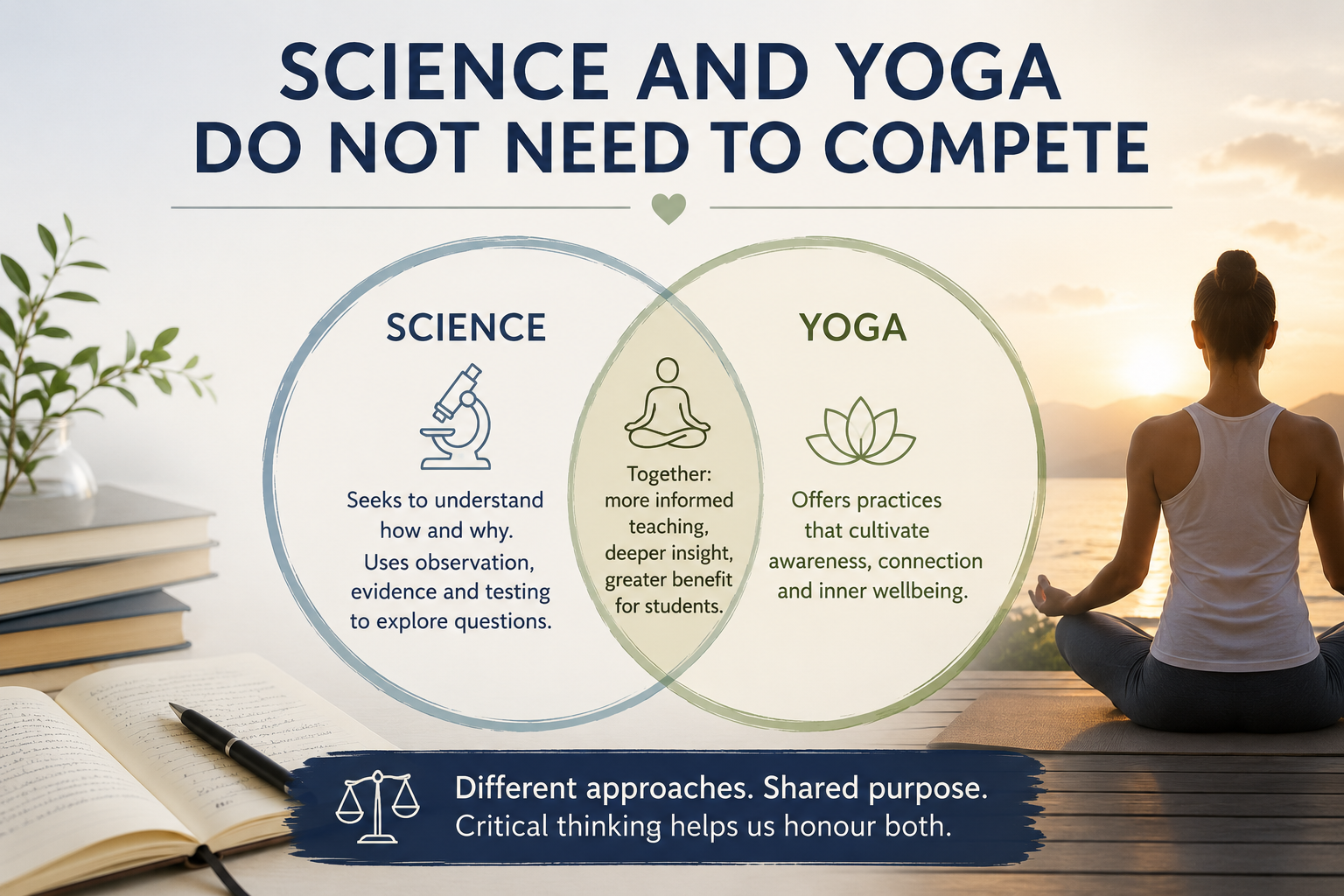
Yoga teachers do not need to become scientists. But developing a basic understanding of evidence can help us communicate more responsibly and confidently.
What might be happening instead?
One of the most useful habits in critical thinking is asking:
“What else could explain this?”
For example:
● Did yoga improve someone’s pain because of movement, social connection, expectation, stress reduction, improved sleep, or simply the passage of time?
● Did a student feel emotional in a class because of a hip opener specifically, or because slowing down created space for reflection?
● Did a breathing practice help because of the technique itself, or because the student paused and rested?
Human experiences are often multifactorial and messy.
Critical thinking helps us resist oversimplified explanations.
Why this matters for yoga teachers
Critical thinking is not about stripping yoga of meaning or tradition.
It is about:
● communicating with integrity,
● acknowledging uncertainty when appropriate,
● reducing fear-based messaging,
● and helping students make informed decisions.
Ironically, saying “we do not fully know yet” can actually build trust.
Students do not necessarily need certainty from teachers. Often, they need honesty, curiosity, and thoughtful guidance.
Critical thinking can also help yoga teachers:
● avoid overpromising outcomes,
● navigate conflicting information online,
● communicate professionally with healthcare providers,
● and feel more confident discussing science without overstating it.
Practical takeaways
Here are a few useful habits to cultivate:
● Pause before repeating strong physiological claims.
● Ask whether a claim has evidence, plausibility, or simply popularity.
● Be willing to update your views when new evidence emerges.
● Separate personal experience from universal truth.
● Use language like “may,” “might,” or “for some people” when certainty is not possible.
● Stay curious rather than defensive when challenged.
● Remember that nuance is not weakness.
Critical thinking is not about becoming cold or sceptical.
It is about learning how to think more clearly in a world overflowing with certainty.
References:
Büssing, A., Michalsen, A., Khalsa, S. B., Telles, S., and Sherman, K. J. (2012). Effects of yoga on mental and physical health: A short summary of reviews. Evidence-Based Complementary and Alternative Medicine, 2012, 165410.
Cramer, H., Lauche, R., Langhorst, J., and Dobos, G. (2013). Yoga for depression: A systematic review and meta-analysis. Depression and Anxiety, 30(11), 1068-1083.
Paul, R., and Elder, L. (2019). The miniature guide to critical thinking concepts and tools. Foundation for Critical Thinking Press.
Russell, B. (1929). Sceptical essays. George Allen & Unwin.
Sackett, D. L., Straus, S. E., Richardson, W. S., Rosenberg, W., and Haynes, R. B. (2000). Evidence-based medicine: How to practice and teach EBM. Churchill Livingstone.