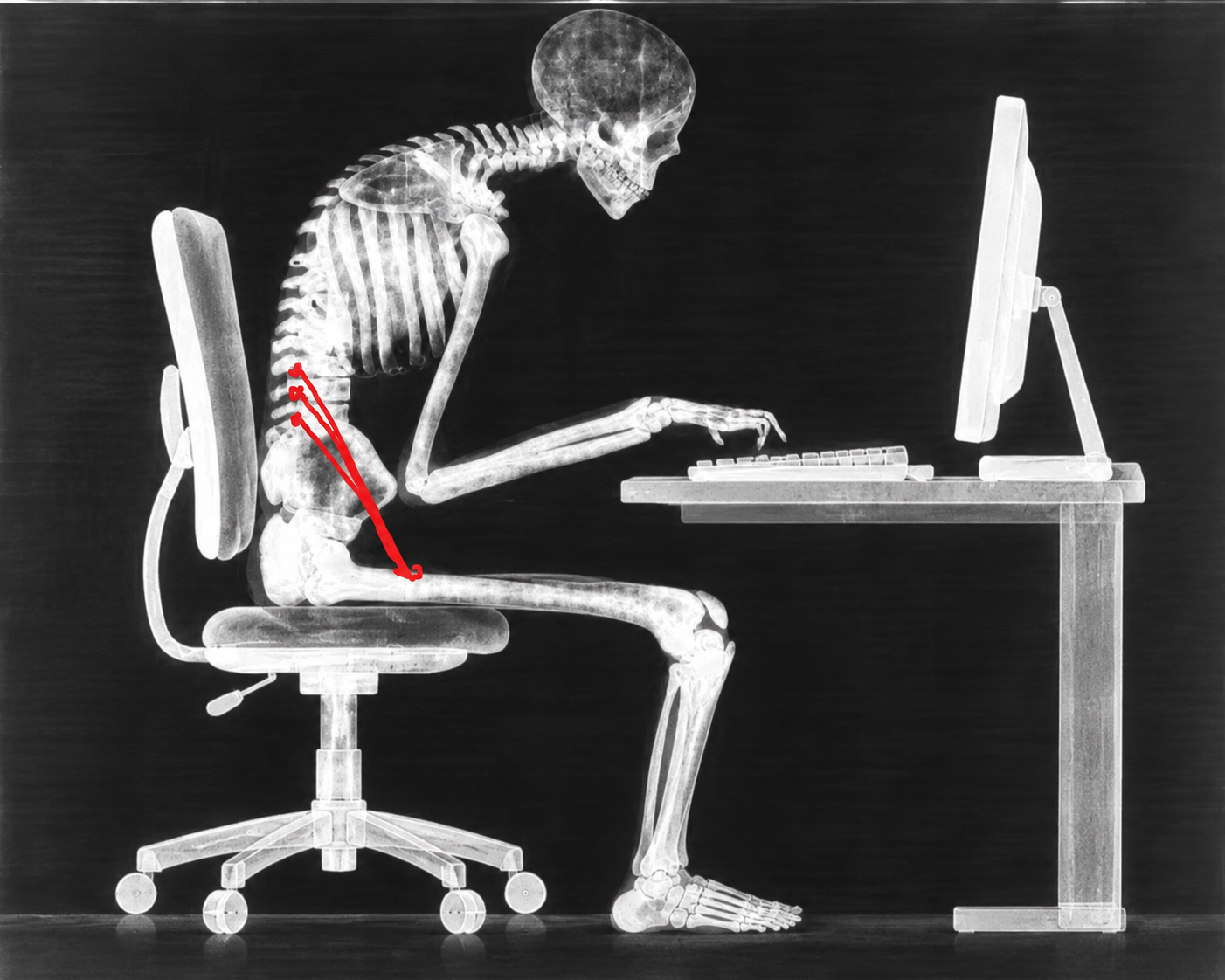
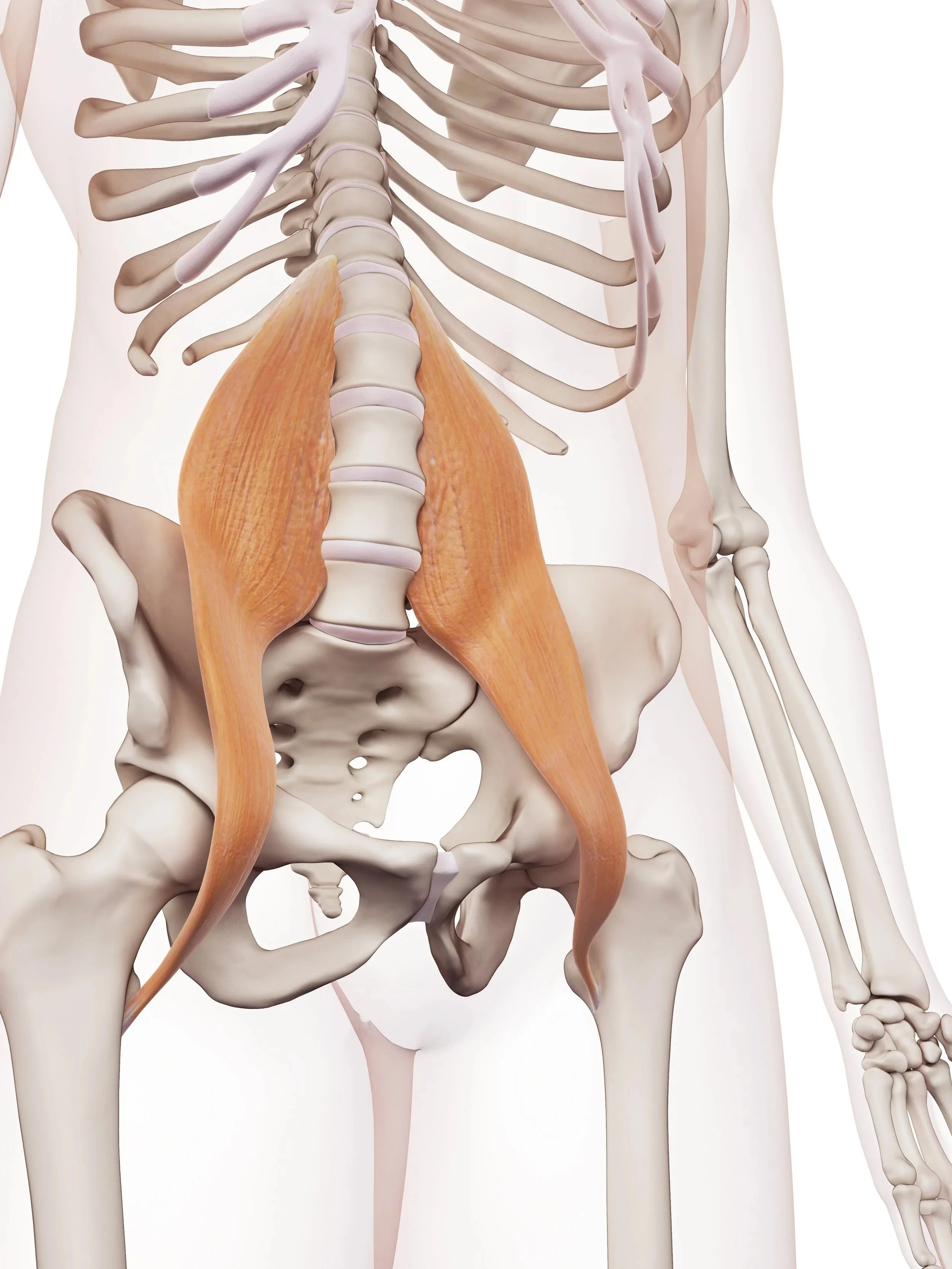
Most yoga teachers have probably heard some version of this explanation: we spend too much time sitting, which keeps the psoas, one of our major hip flexor muscles, in a shortened position. Over time, the muscle itself becomes shorter, pulling the pelvis forwards and potentially contributing to back pain. It is a neat anatomical story, and after several hours at a desk, many of us genuinely do stand up feeling stiff through the front of the hips. But does sitting actually shorten the psoas?
Feeling short and being short are different things
One difficulty with conversations about the psoas is that several different things can easily become conflated. Someone might feel tight or stiff around the front of their hip. They might have relatively limited hip extension when stepping into a lunge. Or there might have been a longer-term structural change within the muscle itself. These things can overlap, but they are not interchangeable.
This matters because we can easily ask someone how their hips feel or observe how far they move into hip extension. Neither tells us directly how long their psoas is. Limited hip extension can have many possible influences, and observing a movement at the hip is not the same as directly measuring the length of one particular muscle.
The same caution applies to sensation. If someone tells us their hips feel tight after sitting, I see no reason to doubt their experience. Staying in almost any position for hours can influence how we subsequently feel when we move. But feeling tight does not tell us which tissue is responsible, or whether that tissue has become structurally shorter.
Following the anatomical story
Could spending many hours with the psoas in a relatively shortened position encourage some kind of adaptation? Potentially. Skeletal muscle is adaptable, and sufficiently prolonged or repeated exposure to particular muscle lengths can lead to changes in its structure. But knowing that muscles can adapt in this way is very different from demonstrating that ordinary sitting causes the psoas to become chronically shorter. A muscle being in a shortened position for part of the day is not, by itself, evidence that its resting length has permanently changed.
This is where a plausible anatomical explanation can quietly gather certainty. Sitting places the psoas in a relatively shortened position. A relatively shortened position becomes a “short psoas”. The short psoas is then said to pull the pelvis into anterior tilt, which is linked with increased lumbar lordosis (the inward curve of the lower back), and eventually low back pain. The progression may sound anatomically reasonable, but it introduces a new assumption at every step.
I find this useful to think about because none of those individual ideas needs to be ridiculous for the overall story to become more certain than the evidence allows. The psoas can influence the hip, pelvis and lumbar spine, and posture, activity and symptoms can interact. The problem comes when anatomical plausibility gradually becomes a confident explanation of cause and effect.
By the time we arrive at “your back hurts because sitting shortened your psoas”, we have travelled quite a long way from what we can actually observe.
What does this mean for yoga teachers?
Perhaps the most useful question is simply: how would we actually know that someone’s psoas was short?
Limited hip extension does not directly measure psoas length. An anteriorly tilted pelvis does not tell us the resting length of the psoas. Feeling a strong stretch through the front of the hip in a Low Lunge does not neatly identify which tissue is producing that sensation. These observations may give us useful information, but they do not provide a diagnosis of a structurally shortened muscle.
For yoga teachers, I think this can be surprisingly liberating. A student may say, “My hips feel really tight because I’ve been sitting at my desk all day.” We do not need to correct them and tell them that nothing is tight. Perhaps moving into a Low Lunge feels wonderful. Perhaps walking around or practising a few Sun Salutations helps them feel less stiff. If movement or stretching feels helpful, that seems useful information.
What we can avoid is automatically adding an explanation that we cannot substantiate: “Sitting all day has shortened your psoas, so we need to lengthen it.” We can respond to what someone feels and how they move without deciding what has happened to one particular muscle.
And I don’t think the alternative message should be that sitting is harmless or stretching is pointless. Prolonged sitting may influence how someone feels when they subsequently move, and sitting habits may coexist with relatively little movement variety. The claim I have become less convinced by is much more specific: that sitting necessarily produces a chronically shortened psoas that needs fixing.
This distinction extends well beyond the psoas. As yoga teachers, we encounter anatomical explanations all the time: a particular posture means a particular muscle is tight, which causes a particular alignment, which eventually causes pain. Sometimes there may be something useful within these explanations. But I think it is worth noticing when we have moved from something we can observe, to a plausible hypothesis, and then to a claim that sounds much more certain.
Perhaps we don’t always need to know exactly which tissue is responsible before we can help someone explore movement.
Demystifying the psoas
This is one of the ideas we explored in more depth in the recent Yoga Anatomy Insights Monthly Masterclass, Demystifying the Psoas. We looked at what the psoas actually does, how confidently we can assess it, its relationship with posture and back pain, what stretching and strengthening might achieve, and some of the bigger claims surrounding this fascinating muscle.
Premium subscribers can now watch the full masterclass replay, along with recordings of all previous sessions.
Find out more about the Monthly Masterclass Series
And if stretching your hips after sitting at your desk feels good, there is no reason this newsletter should persuade you to stop. But if the psoas has not necessarily become structurally shorter, another interesting question emerges: what exactly changes when we stretch, massage or “release” it and suddenly feel better? I’ll explore that in an upcoming post.