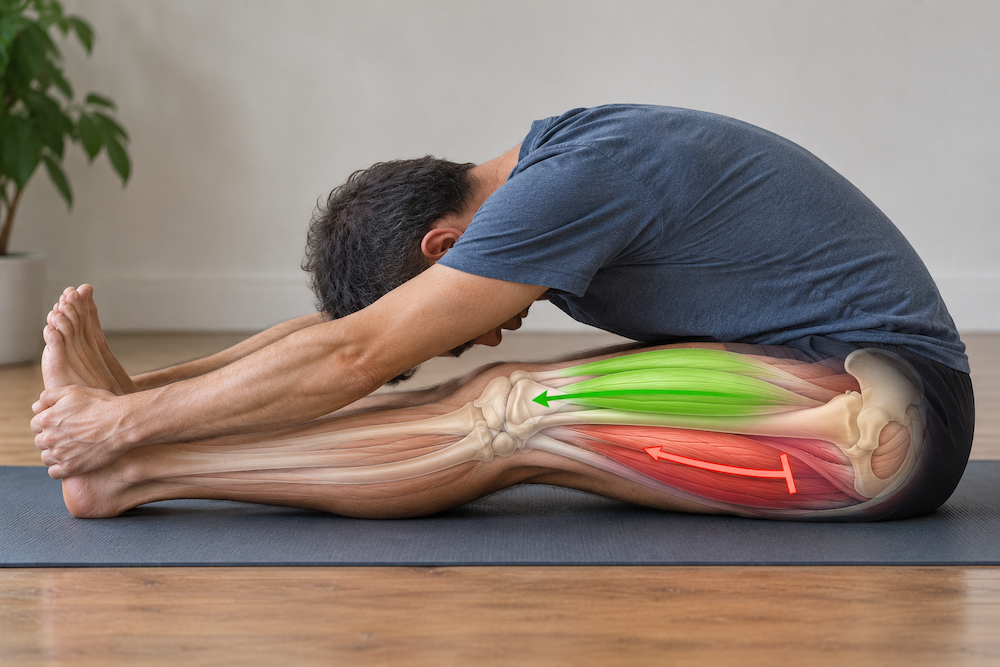
Most yoga teachers have probably encountered the principle of reciprocal inhibition. It's often used to explain why contracting the quadriceps during a forward fold can help the hamstrings relax, supposedly allowing us to stretch further. It's a convincing explanation, particularly because reciprocal inhibition is a genuine neurological mechanism. But does it actually work in the way we're often taught?
This newsletter is adapted from my book The Physiology of Yoga, which explores what is actually happening inside the body when we practise yoga.
What is reciprocal inhibition?
Movement involves constant communication between our muscles, spinal cord and brain. Reciprocal inhibition describes a neurological mechanism through which activity in one muscle can reduce the activation of an opposing muscle. One familiar example involves the stretch reflex. When specialised sensory receptors called muscle spindles detect a stretch, they can activate pathways in the spinal cord that encourage the stretched muscle to contract while inhibiting its opposing muscle. For example, a sudden stretch of the quadriceps can produce a reflex contraction of that muscle while reducing activity in the hamstrings. This helps coordinate the response, but it's important to recognise that reciprocal inhibition is only one of several mechanisms involved in controlling movement.
During walking, for example, our nervous system continually coordinates activity between the muscles responsible for moving the leg forwards and those helping to slow it down. Towards the end of the forward swing, the hamstrings become active to help decelerate the leg before the foot contacts the ground. Muscle activity is constantly being adjusted according to the movement, rather than following a simple pattern in which one muscle group contracts and another completely relaxes. Reciprocal inhibition can contribute to this coordination, but its influence depends on the task and the other signals reaching the muscles.
Can opposing muscles contract at the same time?
One assumption sometimes associated with reciprocal inhibition is that opposing muscle groups cannot contract simultaneously. However, co-contraction, where muscles on opposite sides of a joint are active together, is a normal and useful part of movement. It helps us control joint position, manage forces and respond to changing demands. This is particularly relevant in yoga, where we frequently hold positions that require several muscle groups to work together.
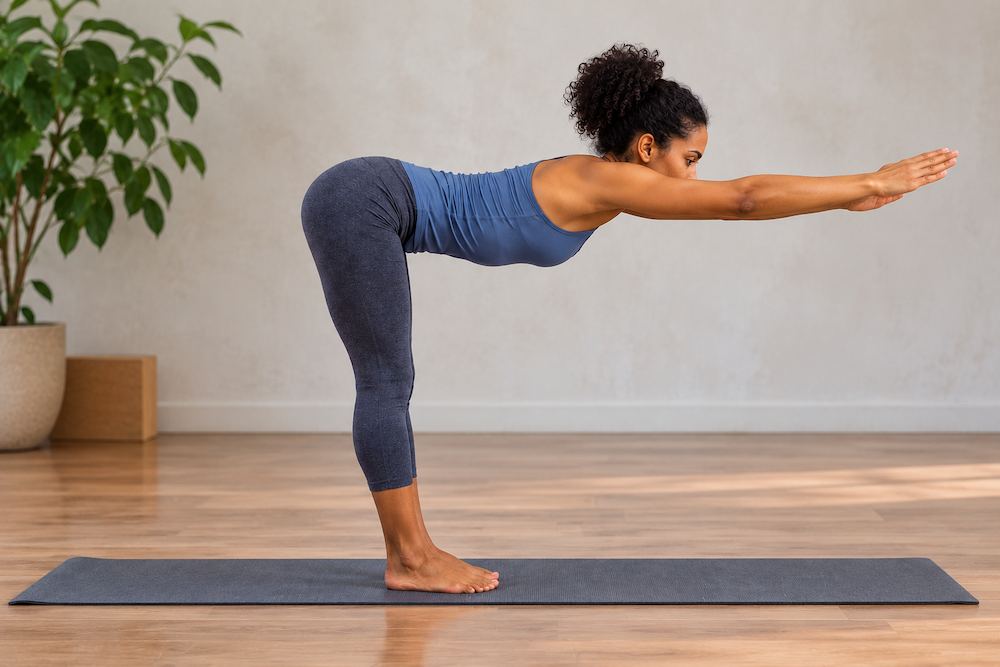
Consider lowering yourself into a standing forward fold. Gravity helps pull your upper body towards the floor, but the movement doesn't necessarily have to be passive. Your hamstrings and other muscles may remain active as they lengthen, helping to control your descent. This is an example of an eccentric contraction, where a muscle produces force while lengthening. Similarly, when holding a standing pose, muscles on opposite sides of a joint may be active simultaneously to help maintain the position. The amount of activity will depend on the forces involved and what we're trying to achieve. This doesn't mean reciprocal inhibition has stopped working. It simply means that inhibitory signals can coexist with other signals encouraging muscle activity. The nervous system combines these different inputs to produce the movement or stability required.
Can reciprocal inhibition help us stretch further?
The idea that reciprocal inhibition can increase flexibility has been around for decades. It's frequently mentioned when explaining proprioceptive neuromuscular facilitation (PNF), a collection of stretching techniques that combine muscle contractions with stretching. One approach involves contracting the muscle opposing the one being stretched, based on the assumption that reciprocal inhibition will encourage the stretched muscle to relax and allow greater range of movement. However, demonstrating that a technique improves flexibility doesn't necessarily establish why it works.
A study by Davis and colleagues (2005) compared three approaches to improving hamstring flexibility in 19 young adults: self-stretching, static stretching and a PNF technique designed around reciprocal inhibition. After four weeks, all three stretching groups had improved compared with their starting measurements, but only static stretching produced a statistically significant improvement compared with the control group. This is interesting because it challenges the assumption that adding a contraction necessarily makes stretching more effective. However, the study was small, with only four or five participants in each group, and examined one particular stretching protocol. We shouldn't interpret its findings as evidence that techniques involving reciprocal inhibition are generally ineffective.
A review by Sharman and colleagues (2006) explored PNF stretching and its proposed physiological mechanisms. The authors reported that certain PNF techniques can be effective for improving range of movement, including approaches involving contraction of the opposing muscle group. However, they also highlighted uncertainty about the mechanisms responsible for these improvements. This distinction is important because we can observe a change in flexibility without knowing exactly which neurological or mechanical processes produced it.
More recent research has continued to challenge some traditional explanations for improvements in flexibility. A review by Freitas and colleagues (2018) examined whether stretching over time changes the mechanical properties of muscles and tendons. The findings suggested that improvements in range of movement cannot always be explained by changes in tissue properties, with factors such as stretch tolerance potentially contributing. Stretch tolerance refers to how much stretching someone is willing or able to experience before deciding to stop. This doesn't mean muscles and tendons never adapt to stretching, but it does remind us that greater range of movement isn't necessarily evidence that a muscle has become physically longer or more relaxed.
So, if contracting the quadriceps helps someone move further into a hamstring stretch, reciprocal inhibition might contribute, but other explanations are possible. The contraction might help actively straighten the knee, change the forces acting around the joint or influence how the stretch feels. Without directly measuring muscle activation and the relevant neurological responses, we cannot confidently attribute the improvement to reciprocal inhibition. It's also worth remembering that a muscle can produce force while lengthening, so the presence of a stretch doesn't necessarily mean the muscle is relaxed.
What does this mean for yoga teachers?
I don't think we need to abandon cues encouraging students to engage their quadriceps during forward folds. Doing so might help them actively straighten their knees, maintain a position or explore a different way of approaching the stretch. Some students might find this useful, while others might prefer to keep their legs relatively relaxed. Neither approach needs to be presented as universally superior, and we don't need to invoke reciprocal inhibition to justify offering either option.
We could even turn this into a simple experiment. Invite students to explore a seated forward fold with their quadriceps relatively relaxed, then repeat it while gently engaging them. Do they notice a difference in their range of movement, the sensation of stretching or their sense of control? It might also be interesting to explore whether engaging the quadriceps changes their experience when the knees are slightly bent compared with when they're straight. These observations won't tell us precisely what's happening neurologically, but they can help students become more curious about their own movement rather than assuming everyone will respond in the same way.
I think this is a useful reminder that physiological explanations can sometimes become more certain in yoga teaching than the evidence justifies. Reciprocal inhibition is real, and it contributes to how our nervous system coordinates movement, but that doesn't mean every practical application attributed to it has been demonstrated. The next time you encourage students to contract one muscle group during a stretch, perhaps consider what you're hoping that contraction will help them achieve. Is it greater range of movement, more active control or simply another way to explore the pose? I suspect those questions will often be more useful than assuming we know exactly what's happening in the opposing muscles.
References:
Davis, D. S., Ashby, P. E., McCale, K. L., McQuain, J. A., & Wine, J. M. (2005). The effectiveness of 3 stretching techniques on hamstring flexibility using consistent stretching parameters. Journal of Strength and Conditioning Research, 19(1), 27–32. https://doi.org/10.1519/14273.1
Freitas, S. R., Mendes, B., Le Sant, G., Andrade, R. J., Nordez, A., & Milanovic, Z. (2018). Can chronic stretching change the muscle-tendon mechanical properties? A review. Scandinavian Journal of Medicine & Science in Sports, 28(3), 794–806. https://doi.org/10.1111/sms.12957
Sharman, M. J., Cresswell, A. G., & Riek, S. (2006). Proprioceptive neuromuscular facilitation stretching: Mechanisms and clinical implications. Sports Medicine, 36(11), 929–939. https://doi.org/10.2165/00007256-200636110-00002