A student easily places their palms on the floor. Their elbows appear to bend backwards in Downward-Facing Dog. They move comfortably into ranges of motion that many other students find challenging.
As yoga teachers, we often describe these students as hypermobile. But what exactly does that mean?
Is hypermobility simply another word for flexibility? Does everyone with hypermobile joints have a syndrome or disorder? And how should yoga teachers approach teaching students whose bodies seem capable of moving far beyond what is considered average?
The answer is more nuanced than many people realise.
-----------------------------------------------------------------------------------------------------------------
What is hypermobility?
Hypermobility simply refers to joints that move beyond what is considered a typical range of motion. This may occur in one joint, several joints, or throughout the body. For example, someone may be able to hyperextend their elbows or knees, bend their thumb towards their forearm, or place their palms on the floor with straight knees.
Importantly, hypermobility itself is not automatically a problem. Many people live their entire lives with hypermobile joints and experience no symptoms whatsoever. In fact, hypermobility is relatively common and may be more prevalent in women, younger individuals, dancers, gymnasts, and some athletic populations (Castori et al. 2017).
This is an important distinction for yoga teachers. Having a hypermobile elbow is not the same thing as having a medical condition.

A spectrum, not a category
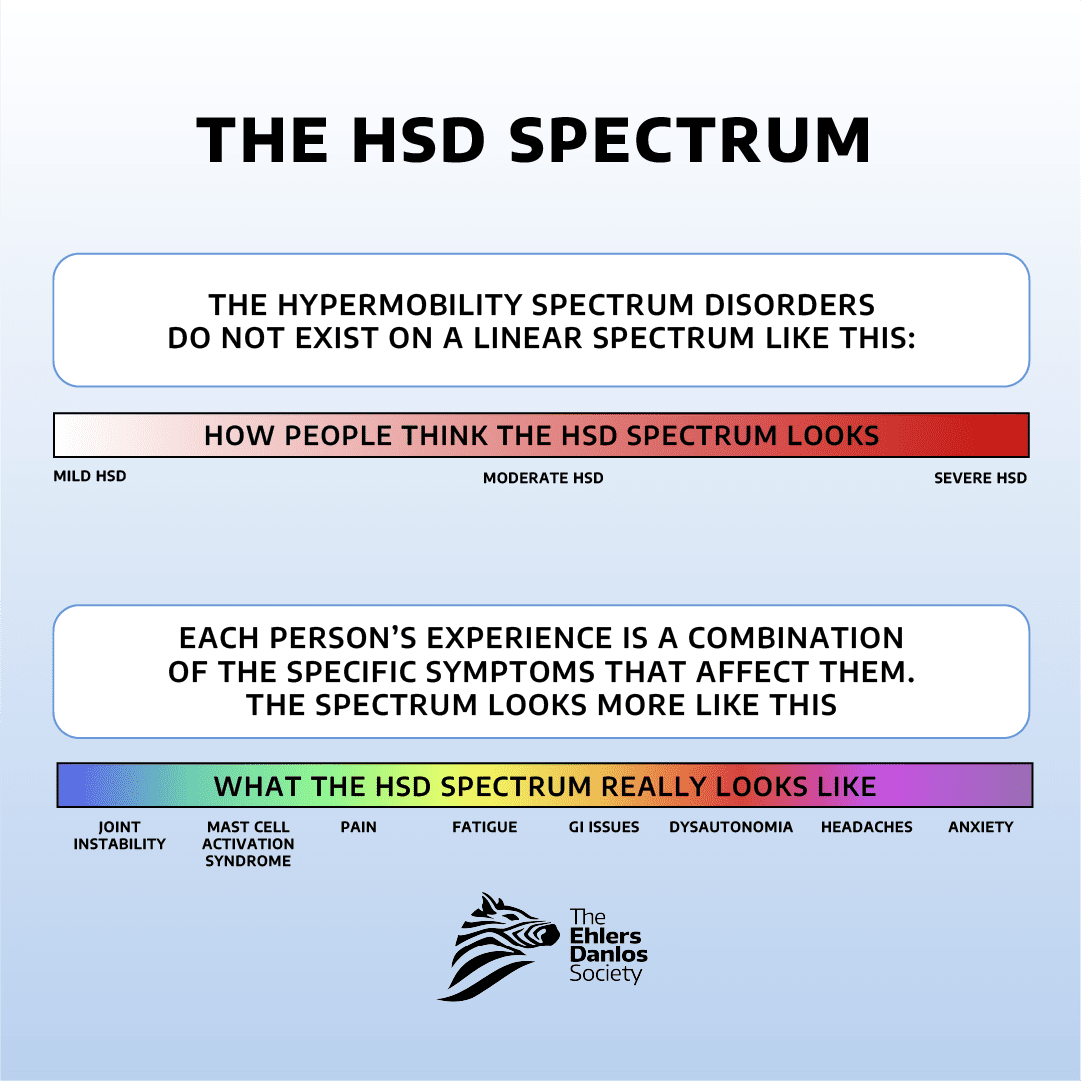
One of the most useful ways to think about hypermobility is as a spectrum rather than a simple yes-or-no category.
At one end are people who simply have greater-than-average ranges of motion. At the other end are people whose hypermobility is associated with symptoms such as pain, fatigue, recurrent injuries, joint instability, autonomic nervous system symptoms, or reduced proprioception. Between these two extremes sits a wide range of experiences.
This helps explain why two students who appear equally flexible may have very different needs. One may move comfortably through large ranges without difficulty. Another may experience fatigue, discomfort, or a sense that their joints never quite feel supported. Looking at movement alone rarely tells the whole story.
HSD and hEDS
In recent years, healthcare professionals have increasingly recognised that some people experience symptoms associated with their hypermobility, even though they do not meet the criteria for a hereditary connective tissue disorder. These individuals may receive a diagnosis of Hypermobility Spectrum Disorder (HSD).
Some people may also be diagnosed with hypermobile Ehlers-Danlos syndrome (hEDS), a hereditary connective tissue disorder associated with joint hypermobility and a range of other symptoms, including chronic pain, recurrent joint instability, fatigue, autonomic nervous system symptoms, and gastrointestinal symptoms (Malfait et al. 2017; Tinkle et al. 2017).
For yoga teachers, the most important point is that hypermobility, HSD, and hEDS are not interchangeable terms. Most flexible students do not have hEDS, and not every hypermobile student has a syndrome or disorder.
Teaching considerations
One of the most common misconceptions is that hypermobile students are automatically fragile. In reality, many hypermobile people are strong, resilient, and highly capable movers.
At the same time, some students may benefit from a broader movement toolkit than simply pursuing ever-greater ranges of motion. Depending on the individual, this may include strength training, balance work, slower controlled movement, end-range awareness, and appropriate recovery.
Rather than assuming that every hypermobile student should avoid end range, it may sometimes be more useful to ask, “How can I help this student feel more confident and supported within the range they already have?”
Avoiding diagnosis
This may be the most important takeaway of all.
Yoga teachers are not trained to diagnose hypermobility spectrum disorders, Ehlers-Danlos syndrome, or other medical conditions. It can be tempting to see a student with large ranges of movement and immediately label them as hypermobile, or assume they have a particular syndrome. Neither assumption is necessarily correct.
Our role is not to diagnose. Our role is to observe, listen, adapt, and teach. If a student has concerns about pain, fatigue, instability, or symptoms that affect their quality of life, referral to an appropriately qualified healthcare professional may be the most appropriate next step.
Why this matters for yoga teachers
The language we use shapes how students understand their bodies. When we assume that hypermobility automatically explains a student's experience, we risk overlooking important individual differences. Two people with similar ranges of motion may have very different needs.
A more helpful approach is to recognise that hypermobility is simply one aspect of human variation. Some students will need very little adaptation. Others may benefit from a different approach to movement, loading, recovery, and practice. The goal is not to fear hypermobility, nor to celebrate it uncritically. The goal is to understand it.
One of the most common misconceptions about hypermobility is that highly mobile people should never feel stiff or tight. In reality, many hypermobile students report exactly the opposite experience. We will explore that paradox in a future newsletter.
References:
Castori, M., Tinkle, B., Levy, H., Grahame, R., Malfait, F., & Hakim, A. (2017). A framework for the classification of joint hypermobility and related conditions. American Journal of Medical Genetics Part C: Seminars in Medical Genetics, 175(1), 148–157.
Malfait, F., Castori, M., Francomano, C. A., Giunta, C., Kosho, T., & Byers, P. H. (2017). The 2017 international classification of the Ehlers-Danlos syndromes. American Journal of Medical Genetics Part C: Seminars in Medical Genetics, 175(1), 8–26.
Scheper, M. C., de Vries, J. E., de Vos, R., Verbunt, J., Nollet, F., & Engelbert, R. H. (2017). Generalised joint hypermobility in professional dancers: A sign of talent or vulnerability? Rheumatology, 52(4), 651–658.
Tinkle, B., Castori, M., Berglund, B., Cohen, H., Grahame, R., Kazkaz, H., & Levy, H. (2017). Hypermobile Ehlers-Danlos syndrome and hypermobility spectrum disorders: Clinical description and natural history. American Journal of Medical Genetics Part C: Seminars in Medical Genetics, 175(1), 48–69.