A few weeks ago, a student asked me a familiar question:
"I've hurt my shoulder. Should I stop practising yoga until it heals?"
Questions like this arise frequently. Whether it is a shoulder, knee, back, or hamstring, many students assume recovery is simply a matter of resting the injured body part until it gets better.
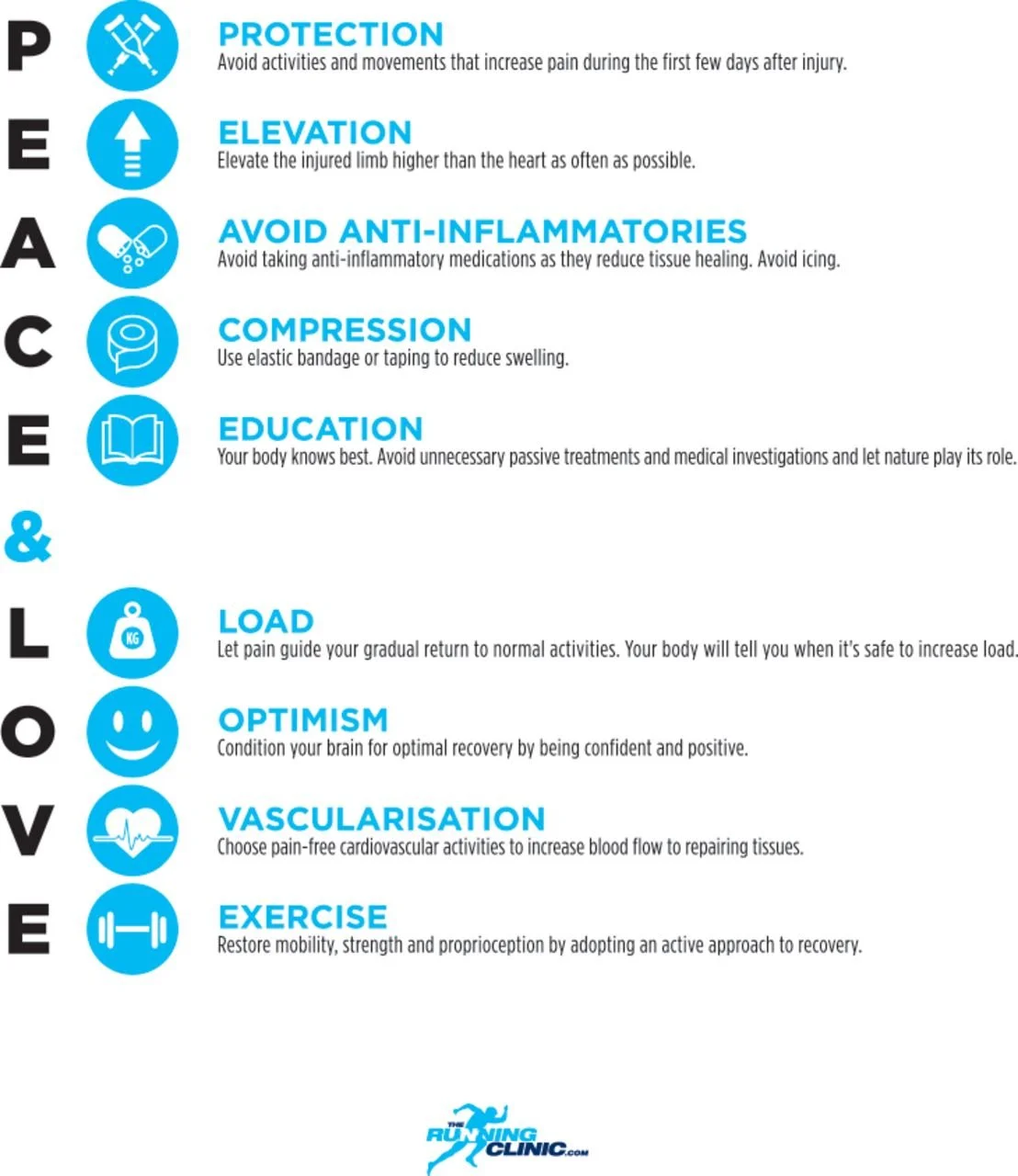
Yet our understanding of injury recovery has changed considerably over the past few decades. In fact, a group of researchers proposed that many soft tissue injuries simply need PEACE and LOVE (Dubois & Esculier, 2020).
No, this is not yoga philosophy. It is an evidence-based framework for injury management.
You might be surprised to learn that this framework no longer recommends routinely icing an injury or taking anti-inflammatory medications such as ibuprofen.
What is the new framework?
Many of us grew up hearing the acronym RICE: rest, ice, compression, elevation.
More recently, researchers have suggested a broader framework called PEACE & LOVE, which acknowledges that healing is not only about tissues. It is also influenced by movement, education, confidence, and psychological factors (Dubois & Esculier, 2020).
PEACE applies during the first few days after injury:
Protect
Elevate
Avoid anti-inflammatory medication
Compress
Educate
LOVE applies during the following stages of recovery:
Load
Optimism
Vascularisation
Exercise
What stands out to me is not the acronym itself. It is the recognition that recovery involves much more than simply waiting for tissues to heal.
What does the research say?
One of the most surprising aspects of the framework is the recommendation to avoid routinely using anti-inflammatory medication in the early stages of recovery.
After all, inflammation is often viewed as something to reduce as quickly as possible.
However, acute inflammation is a normal and important part of the healing process. Following an injury, inflammatory cells help clear damaged tissue and initiate the cascade of events that supports repair. Some researchers have therefore questioned whether routinely suppressing this response with anti-inflammatory medications, particularly in the early stages, might impair long-term tissue healing (Dubois & Esculier, 2020; Bjordal et al., 2003).
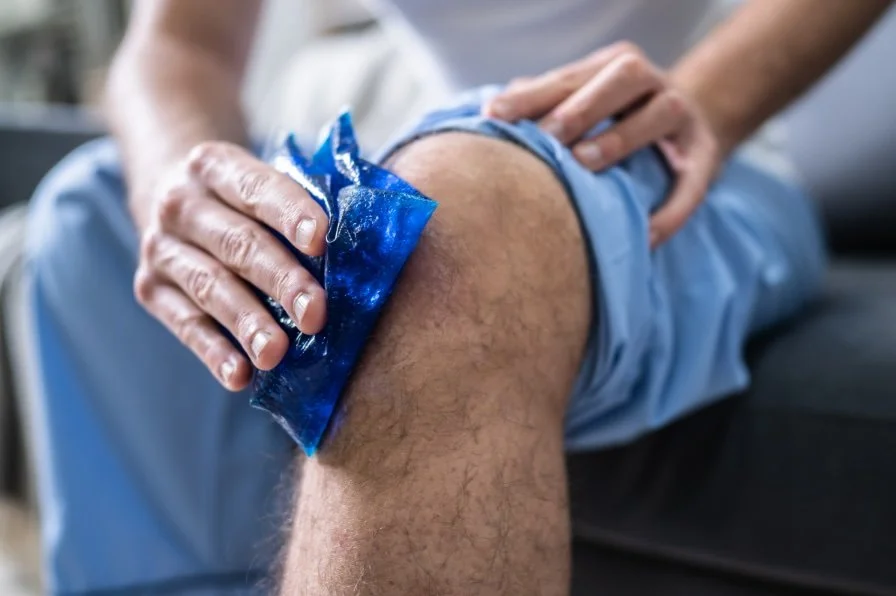
Similarly, while ice may temporarily reduce pain, there is ongoing debate about whether aggressively limiting inflammation is always beneficial for recovery. This is one reason why ice no longer occupies the central role it once did in many injury management guidelines.
The framework also highlights something many people find surprising: optimism matters.
Psychological factors such as fear, catastrophising, anxiety, and low confidence have been associated with poorer recovery outcomes across a range of musculoskeletal conditions (Linton & Shaw, 2011).
This does not mean injuries are "all in the mind". It means that healing is influenced by both biological and psychological factors.
Why this matters for yoga teachers
Yoga teachers are not physiotherapists, and most of us are not responsible for diagnosing or treating injuries. However, we do influence how students think about their bodies. When a student experiences pain or injury, our language can either support confidence or increase fear.
Consider the difference between these statements:
"Your shoulder is damaged, be very careful."
"Your shoulder may need some time and appropriate loading, let's explore what feels manageable today."
Neither statement guarantees a particular outcome, but one is more likely to encourage confidence and continued engagement with movement.
As yoga teachers, this also serves as a useful reminder that not every biological process needs to be "fixed". Inflammation often has a negative reputation, but in the right context it is a normal, adaptive response that helps the body recover. The goal is not always to eliminate a process, but to understand the role it plays.
Many of the ideas that become embedded in yoga culture begin with the language we use.
Practical takeaways
When students are navigating injuries:
Encourage them to seek appropriate medical advice when needed.
Avoid assuming complete rest is always the answer.
Remember that movement is often part of recovery, not the enemy of recovery.
Be cautious about language that creates fear or fragility.
Recognise that confidence, expectations, and beliefs may influence how people experience recovery.
Remember that inflammation is not always the problem. In many cases it is part of the solution.
Healing is complex. It involves tissues, movement, psychology, environment, lifestyle, and time. Perhaps that is why a framework called PEACE & LOVE resonates with so many people.
References:
Bjordal, J. M., Ljunggren, A. E., Klovning, A., & Slørdal, L. (2003). Non-steroidal anti-inflammatory drugs, including cyclooxygenase-2 inhibitors, in acute soft tissue injury management: A systematic review of randomised controlled trials. British Journal of Sports Medicine, 37(6), 491-496.
Dubois, B., & Esculier, J. F. (2020). Soft-tissue injuries simply need PEACE and LOVE. British Journal of Sports Medicine, 54(2), 72-73. https://doi.org/10.1136/bjsports-2019-101253
Linton, S. J., & Shaw, W. S. (2011). Impact of psychological factors in the experience of pain. Physical Therapy, 91(5), 700-711.