Chaturanga Dandasana is one of the most recognisable postures in modern yoga, yet it is also one of the most misunderstood. For many students, it is the point in a Sun Salutation where strength gives way, shoulders wobble, or elbows seem to have a mind of their own. For yoga teachers, it is a pose surrounded by rules. Hands must be directly beneath the shoulders. Elbows must stay glued to the ribs. Anything else is often viewed as poor technique.
But are these rules grounded in anatomy, or have they simply become embedded in yoga culture?
A closer look at the mechanics of Chaturanga suggests that the movement is more nuanced than many of us have been taught.
What is Chaturanga asking for?
Rather than thinking of Chaturanga as simply lowering halfway to the floor, it can be helpful to think about the movements involved.
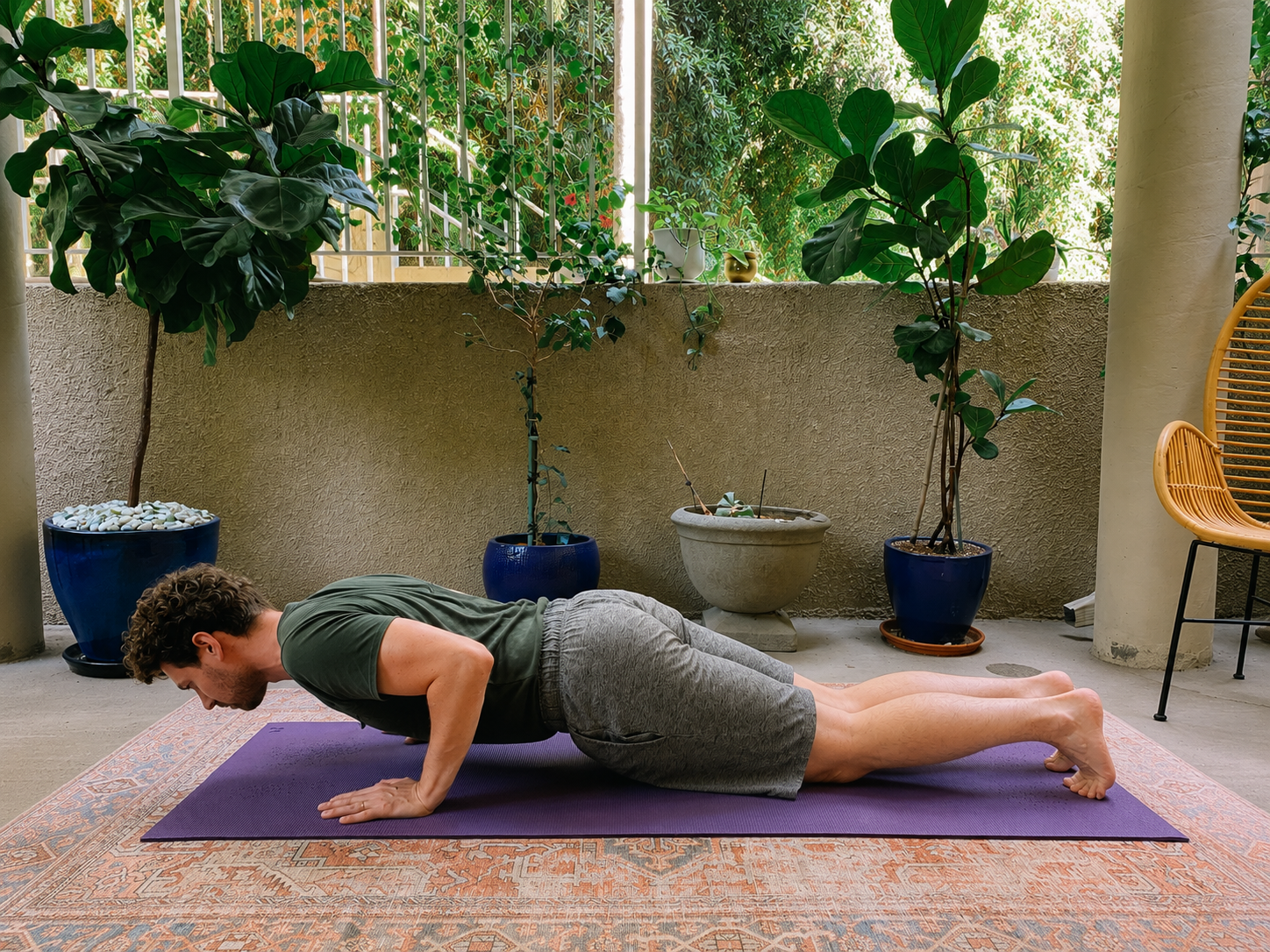
As we lower from Plank into Chaturanga, the elbows bend and the shoulders move into extension. Although it looks like a movement powered by the biceps and other muscles that bend the elbows, much of the challenge actually comes from controlling the descent. The triceps and shoulder flexors work eccentrically to resist gravity, while the muscles around the shoulder girdle and trunk provide stability throughout the movement.
One of the reasons Chaturanga can feel so demanding is that all of these actions happen simultaneously. If strength, confidence or coordination are still developing, small changes to the amount of loading, such as practising at an incline or lowering the knees first, can make the movement far more accessible without changing the overall movement pattern.
Why don't the elbows always stay tucked in?
One of the most common cues in yoga is to "keep your elbows close to your sides." While this can be a useful teaching intention, it is often presented as though it should be possible for everyone.
The anatomy of the elbow tells a slightly different story.
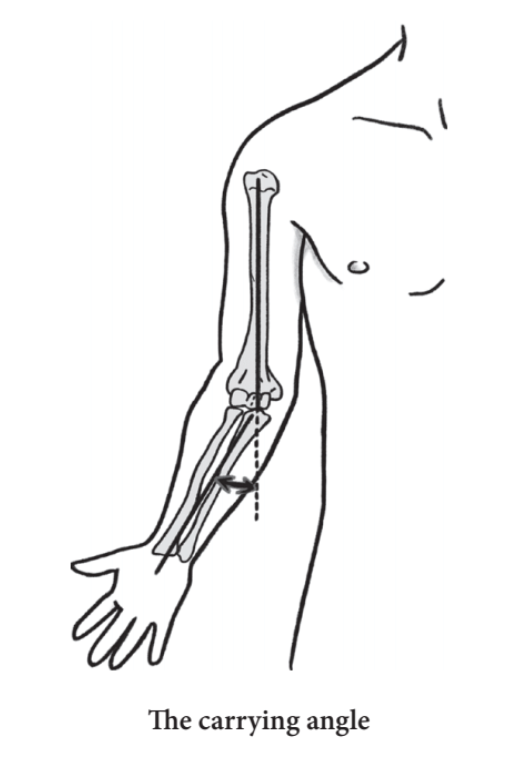
When your arms are straight, your forearms do not form a perfectly straight line with your upper arms. Instead, most people have a small outward angle at the elbow known as the carrying angle. This angle allows the hands to clear the hips during walking and helps position the hand comfortably towards the mouth when the elbow bends (Morrey, 2000).
As the elbows flex during Chaturanga, the forearms naturally move towards the body's midline. If the hands begin directly beneath the shoulders in Plank Pose, the elbows will often drift slightly away from the sides of the torso as part of this normal anatomy.
For many students, this is not a fault. It is simply how their elbows are built.
Why does this matter?
Many teachers respond by asking students to pull their elbows back in towards the ribs. This certainly changes the movement, but it also encourages greater activation of muscles such as latissimus dorsi and pectoralis major, both of which contribute to internal rotation of the shoulder.
Internal rotation is not inherently bad. The problem is that many yoga teachers are simultaneously encouraging students to externally rotate their upper arms while also insisting that their elbows remain tightly tucked against their sides. For some bodies, these cues may compete with one another rather than complement each other.
Instead of chasing one perfect alignment, it may be more helpful to recognise that some variation is a normal consequence of human anatomy.
What might yoga teachers do instead?
Rather than worrying about whether the elbows remain perfectly against the ribs, consider whether the movement looks controlled and comfortable.
One simple option is to experiment with placing the hands slightly wider than shoulder width before lowering. This better accommodates the carrying angle and may allow the elbows to track more naturally throughout the movement.
Equally, it may simply be appropriate to stop correcting every student whose elbows drift a little away from the torso. If the movement is pain-free, controlled and appropriate for the individual, it does not necessarily need fixing.
As with so many aspects of yoga, there is often more than one way to move well.
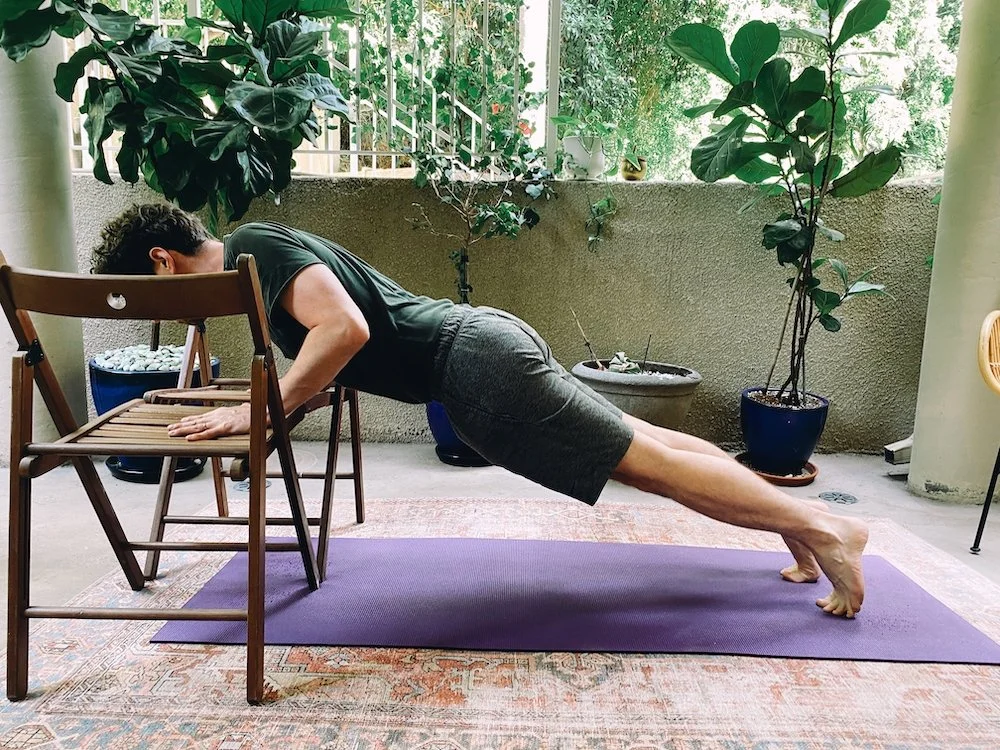
If building strength is the primary challenge, remember that the traditional version of Chaturanga is only one option. Practising at an incline, lowering the knees before the descent, or using props to reduce the loading can all help students develop confidence and control before progressing to more demanding variations.
Why this matters for yoga teachers
Many ideas become established in yoga because they are repeated often enough, not necessarily because they are supported by anatomy or evidence.
Chaturanga reminds us that alignment cues should always be interpreted through the lens of individual variation. Human joints are not identical, and expecting every student to move in exactly the same way can unintentionally encourage unnecessary correction.
As teachers, our role is not to help every student achieve an identical shape. It is to help them move with confidence, control and curiosity within the body they have.
Practical takeaways
Chaturanga is a demanding strength-based movement, not simply a transition between poses.
The elbows naturally move differently from person to person because of the carrying angle.
Hands placed slightly wider than shoulder width may better accommodate normal elbow anatomy.
Elbows drifting slightly away from the torso are not necessarily a sign of poor technique.
Focus on controlled, comfortable movement rather than achieving one "perfect" version of the pose.
Shoulder mobility practice
If your students struggle to maintain shoulder control during Chaturanga, shoulder girdle mobility exercises may help them develop greater awareness and stability. I've put together a short practice here:
Reference:
Morrey, B. F. (Ed.). (2000). The elbow and its disorders (3rd ed.). Philadelphia, PA: W.B. Saunders.